Erdem Moralıoğlu: Strange Threads

Erdem Moralıoğlu at his home in London, 2026. On wall: Pavel Tchelitchew, Head of a Boy (Self Portrait), 1930. On mantlepiece: Jared French, Portrait of Webster Aitken, c.1935. Photography by Vivek Vadoliya
This article was originally featured in Frieze Magazine, September 2026.
From old masters and Wilhelm Lehmbruck to Nan Goldin and Derek Jarman, the fashion designer reflects on the unexpected affinities that shape his art collection.
Phillip Edward Spradley Before you started collecting, were you someone who felt at home in museums and galleries? Was there art in your home when you were growing up? Or was there a particular moment when looking at art became something more personal, something you wanted to take home with you?
Erdem Moralıoğlu I was born in Montreal – my mother was British and my father was Turkish. I moved to London for college and ended up staying. So, half my family is based in the UK and the other half in Turkey. My mother was always very interested in art. If she found something interesting, she would always share it with me and my twin sister Sara.
She loved art. I remember she had an amazing book on Manet, for instance. There was also this book on impressionism in the house. I found it so fascinating. Growing up in Montreal, there were also extraordinary exhibitions. When I was a teenager in 1992, there was the ‘Pop Art’ exhibition at the Montreal Museum of Fine Arts, which completely changed my perception of art and what it could potentially be. The first artwork I bought was actually an illustration by Andy Warhol from the 1950s, when he was doing a lot of commercial art.
There was also the most extraordinary Tamara de Lempicka exhibition at the Montreal Museum of Fine Arts [‘Elegant Transgressions’, 1994]. Even discovering someone like Derek Jarman when I was quite young was fascinating to me. I found that idea of the polymath – the painter, writer and filmmaker – really interesting. It also relates back to the idea of the Factory and to the multidisciplinary approach that I found so compelling.
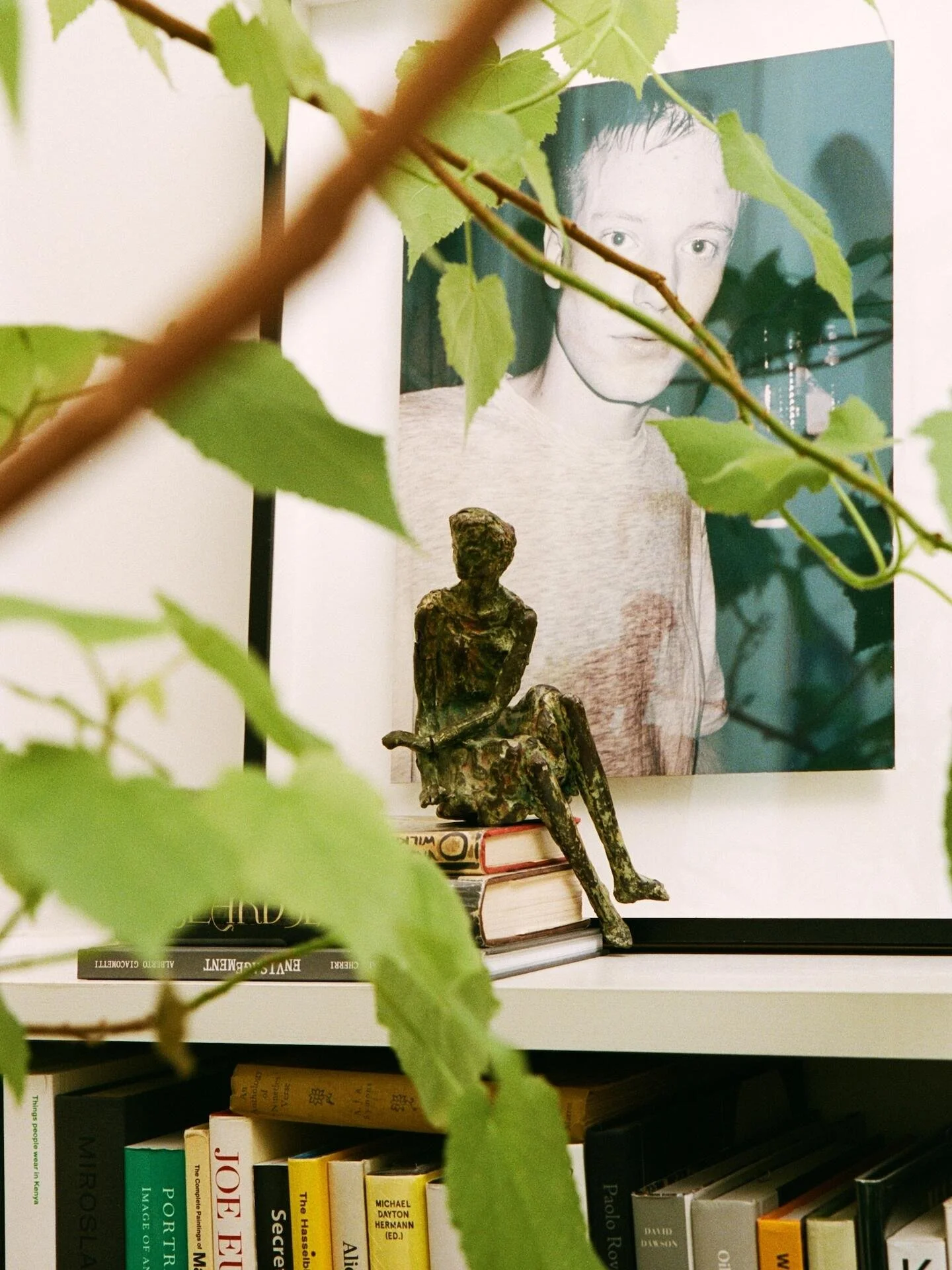
On books: John Bridgeman, Seated Girl I, c.1950. On wall: Wolfgang Tillmans, Young Man, Chemistry, Summer, 1992. Photography by Vivek Vadoliya
PES Is the early work by Warhol a portrait?
EM It’s not a portrait. It was when he was working as a commercial artist and doing a lot of illustrations of shoes and cats and whatnot. It’s an image of a woman in profile, and it looks almost like a kind of cosmetics ad, but it’s really beautiful. I love it. I found it so evocative and glamorous. It’s a wonderful ink drawing.
PES Well, considering that was one of your first purchases and knowing that your collection moves between modernist and pre-war arts, one would say that those categories are quite different. I wonder how you see the conversation between them. What connections have you made over the years as your collection has grown?
EM I don’t quite know how to answer that, because I find myself attracted to certain things for whatever reason. Some things just speak to you. Nan Goldin’s Yogo in the Mirror, Bangkok [1992] is a beautiful portrait I have. I almost consider it a painting, even though it’s a photograph. I went through a phase when I was really interested in photography by women: Anne Collier, Rineke Dijkstra, Nan Goldin and Candida Höfer. There are two photographs by Nan Goldin that I really love. The other one is from the series ‘The Ballad of Sexual Dependency’ [1976–86].
I also have this wonderful portrait of an unknown sitter from the 17th century. It’s an English portrait, and she’s just this solitary figure. And there’s Pavel Tchelitchew: he’s someone I love. Tchelitchew was part of that circle around George Platt Lynes and Jared French – that queer American world of the early 20th century. I’m really obsessed with him and Patrick Procktor. I think there’s something almost biographical about both of their works, the interconnectedness of them.
PES Do the narrative and the history surrounding these artworks captivate you? Doing that research and finding where those relationships lie? Or is it something more instinctive and aesthetic that happens before you know anything about them?
EM Usually, it’s a little bit of both. I might know that I’m looking for something by Tchelitchew or Procktor, so that’s more specific. But then broader things come up that speak to me. Recently, I found a small drawing by Ingres. It’s not something I would normally be interested in, but it was such a beautiful, tiny drawing – a very specific thing that somehow felt like it related to everything else. I think my process of collecting is much more emotional and instinctual. There are these strange threads running through my art collection.
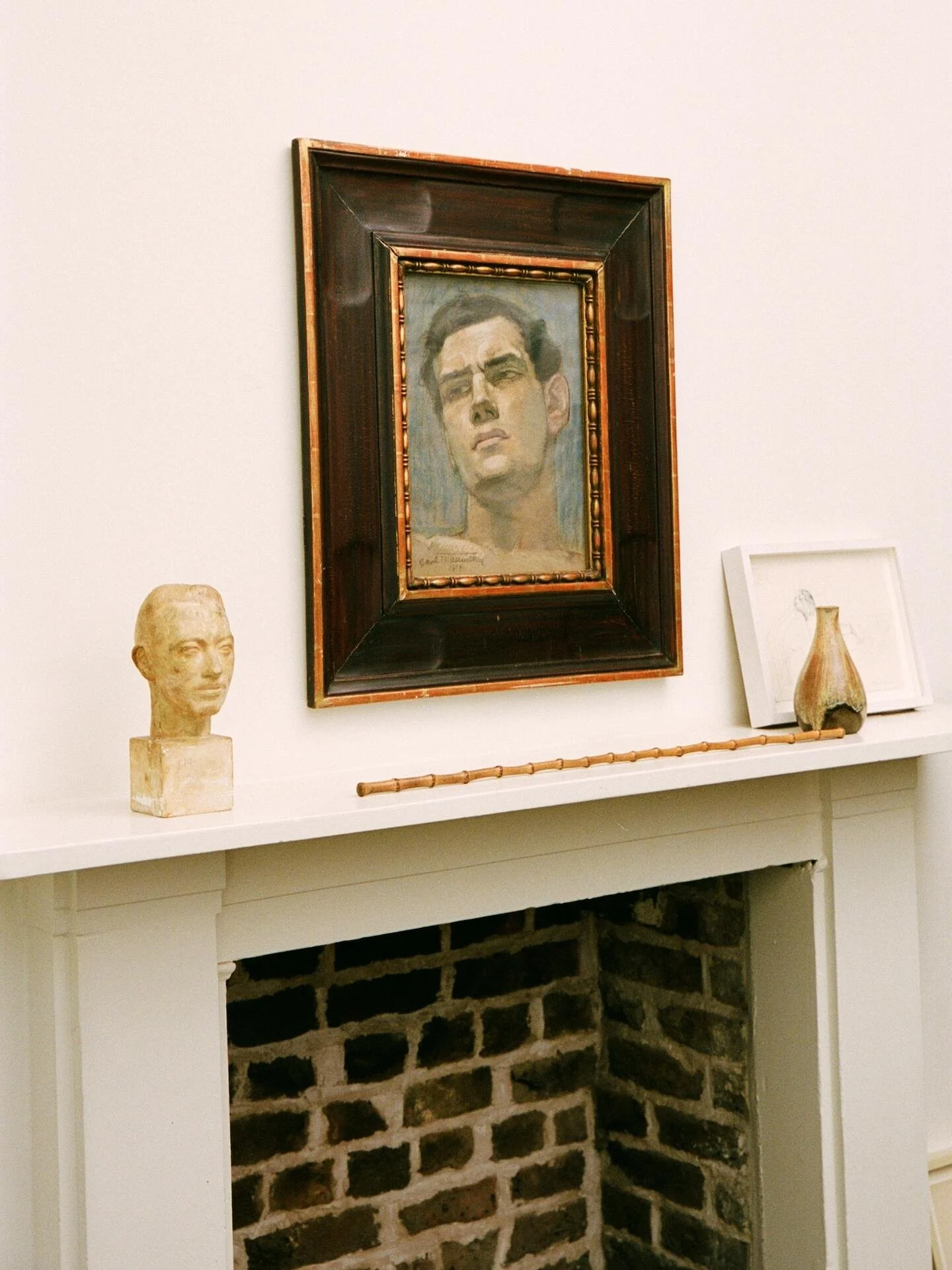
On wall: Albert Männchen, Studienkopf – Junger Mann, 1916. On mantlepiece, left to right: Jared French, Portrait of Webster Aitken, c.1935; Auguste Delaherche, Vase, c.1904–30; Patrick Procktor, Gervase Griffiths, Hotel Salam, 1968. Photography by Vivek Vadoliya
PES How would you describe your relationship between fashion and art? You clearly hold both in high regard, but what does one provide that possibly the other doesn’t?
EM I’m a fashion designer and that’s my job. I have a deep love for fashion. I’m fascinated by the creative process. Maybe there are interesting ways of looking at both fashion and collecting in quite an open way. It’s about how you look at things, perhaps slightly sideways. I find the creative process, and the speed at which you have to work, really interesting. I like the idea of turning the page, moving on and creating a body of work. There’s something similar about the act of collecting: you look at something, you pursue it and then you move on and start examining the next thing. And then you revisit. Things feel more important years later. You refine things and see things differently.
PES When you are researching for a fashion collection, do you consciously avoid looking at your own collection? Or is the conversation between them impossible to avoid?
EM I was looking at Cocteau recently, someone I find really, really interesting. When we talk about Derek Jarman – filmmaker, painter, writer, activist – or Warhol – painter, filmmaker, printer, all of the things that Andy Warhol did – it’s interesting to think about Cocteau before any of them: filmmaker, illustrator, painter.
But I was looking at Cocteau and then came across an artist named Barbette [Vander Clyde Broadway], who was originally from Texas and moved to Paris, where they became a performer exploring ideas around gender fluidity. So, weirdly, yes, sometimes you’ll look at something you’re interested in from the point of view of collecting, and it can lead you to things you might not normally encounter. You read about one thing and it leads you somewhere else. It’s almost unavoidable when you’re interested in something – like Cocteau’s world – that opens on to so many other things.
PES Do you think your fashion instincts translate to collecting or are they fundamentally different? As a designer, are you bringing those same abilities to your interactions with art?
EM There is a similarity: you’re trying to achieve and explore something about beauty and what that is. There’s something about collecting, in the purest sense of the word. When you really think about the word ‘collecting’ – piecing things together, placing them next to each other – I find that really interesting. It’s an instinctual, pure thing, which designing is as well. But the end results lead you to different places.
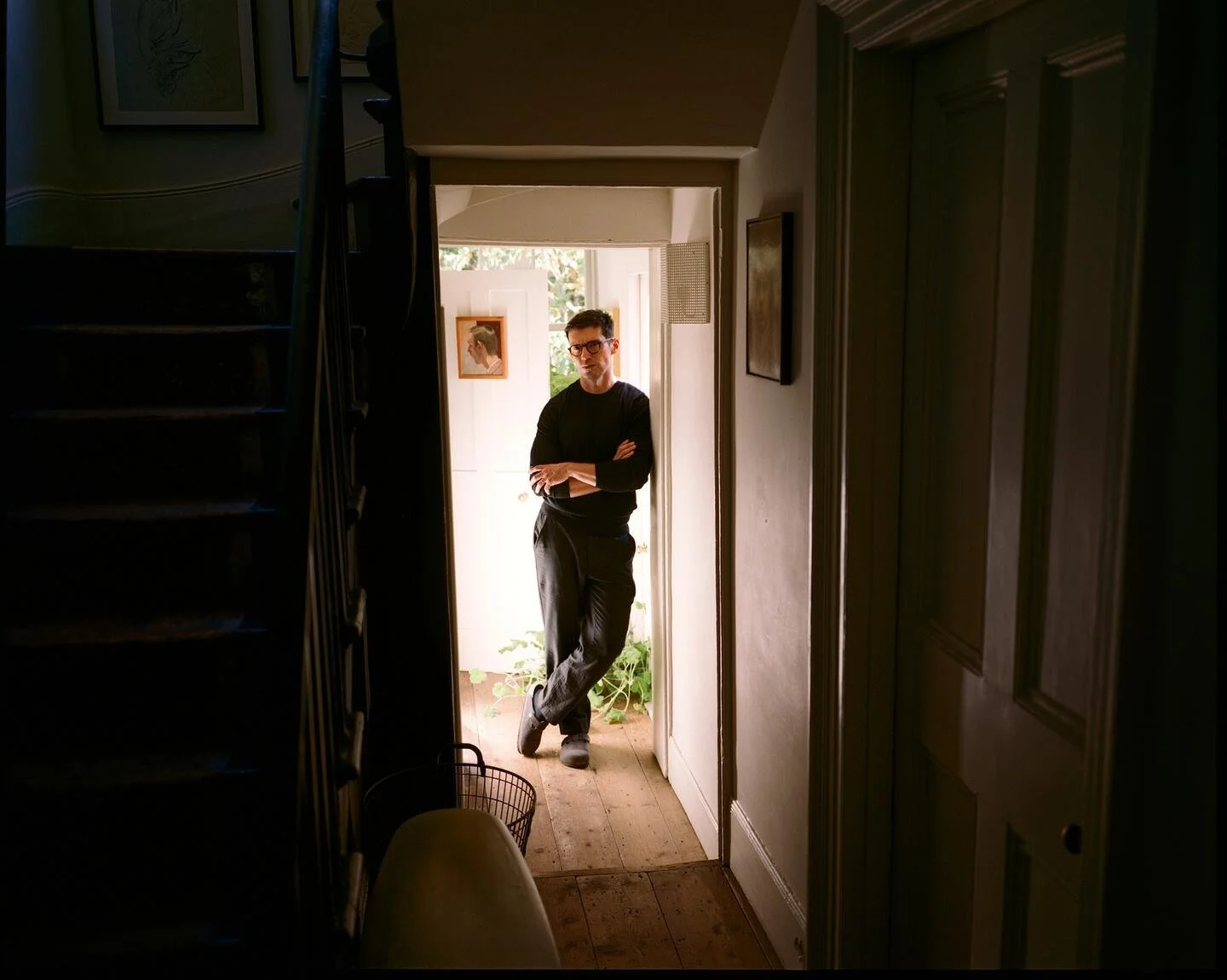
Erdem Moralıoğlu at his home in London, 2026. Photography by Vivek Vadoliya
PES What misconceptions do you believe exist around collecting old masters and pre-war art?
EM I think there’s something extraordinary about a gestural Tracey Emin watercolour that’s visceral sitting next to a controlled 18th-century portrait of a woman, and what the two say to each other. The contrast between those worlds is infinitely interesting to me. To dismiss something because of its time is such a shame. It’s about keeping your eyes open.
When I started collecting – if we consider the Warhol painting the first painting – I was really focused on contemporary photography. I also love Anne Collier. I discovered her through Marc Foxx Gallery in Los Angeles, and I find her work fascinating: the idea of an image of an image, that sense of observation. There’s something very emotional and modern about it.
She had a beautiful show at Lismore Castle in Ireland a few years ago, and her series of women holding cameras is fascinating. But to put that work in the context of Tchelitchew, or something from the Bloomsbury Group, is wonderful. It creates a beautiful dialogue.
PES With your collection of old masters, you’re being a steward, and I wonder how that has changed your understanding of history itself and the way you approach art. As you mentioned, when you acquire works by certain artists and do the research, you build out your own timeline and begin to see connections between a medium or movement, a place and a time. I’m curious how collecting and stewarding these histories has changed your understanding of art overall.
EM The work I have by PaJaMa – the photographic collective formed by painters Paul Cadmus, Jared French and Margaret French in 1937 – is an original photograph, and it’s quite tiny [Jared French (On Lawn, From Roof), Sconset, 1946]. And there’s a Wolfgang Tillmans print that we have – on the subject of photography and editions – of a sunset on Fire Island. Again, I find that interesting because maybe that’s what you’re touching on: this idea of literal histories overlapping, of one man capturing his reality in 2015 versus someone else, or, in this case, an artist collective capturing their reality in 1946. I like that idea of histories overlapping.
One of my favourite things that we have is a painting over a photograph that Derek Jarman took, Saint George and the Dragon [1979–81]. It was from a series of nudes that he did when he was very young. He took the photograph and painted over it with this very thick red paint. There’s a label on the back of it and, of course, it has a big, gestural Jarman signature. It was part of a posthumous exhibition at the Barbican, but only a few years after he passed away. I find there’s something so interesting about that label, that it was part of a show from a generation of artists who didn’t make it, who didn’t survive a very specific period of time. I think about Mark Morrisroe or Robert Mapplethorpe.
PES If someone unfamiliar with your collection walked into your home or the store and saw only the art – no furniture, no racks – what would you hope they would understand about you? What do you think they would take away from just the artworks themselves?
EM I remain curious and open. I’m curious about lots of different things, whether it’s the PaJaMa photo or Wilhelm Lehmbruck, this strange German artist who killed himself after World War I. I love Lehmbruck. I collect his busts because his figures have this extraordinary sense of inwardness. They’re physically present but somehow elsewhere – melancholic, elongated, otherworldly. They create a very particular emotional atmosphere around them.
I’ve realized that a lot of what I collect is connected by this kind of interiority. The works can be completely different in period or medium, but there’s often a solitary figure, a sense of psychological distance or something slightly otherworldly about them. Lehmbruck embodies that very purely: the body is there, but the subject seems to exist somewhere else. I think there’s something deeply human about all the pieces I’m attracted to, even if the connections between them might initially seem quite odd. I hope people come away curious about those connections – maybe they’ll see them as clearly as I do, or maybe they’ll think, ‘What is he doing?’