Daria Denisneko talks to Phillip Edward Spradley
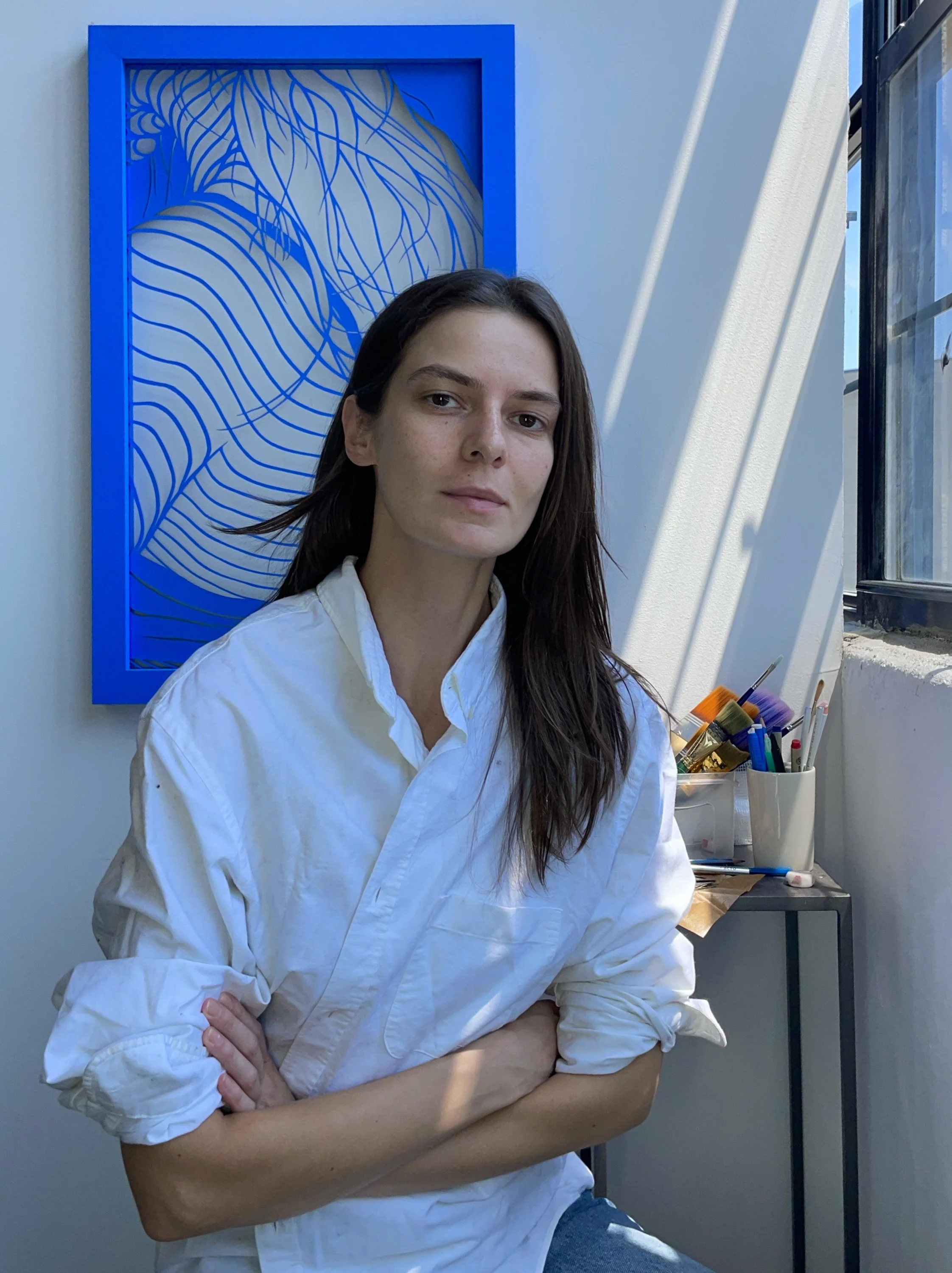
Portrait of Daria Denisenko, 2026. Courtesy of the artist.
The most compelling portraits reveal more than a likeness, they uncover the quiet relationships. Artist Daira Denisenko approaches portraiture not as an act of documentation, but as one of prolonged attention. Each work emerges through relationships cultivated over time, where conversation and observation become as essential as the finished object itself. She is interested in how identity is reflected through the spaces people shape and, in turn, are shaped by. Her interiors are lived rather than staged, carrying the emotional residue of daily rituals that often pass unnoticed.
Working across photography, drawing, painting, and intricately fabricated installations, Denisenko constructs images that resist remaining still. Her distinctive network of contour lines transforms bodies into fluid topographies, allowing skin, furniture, mirrors, and architecture to merge into a continuous visual rhythm. Figures oscillate between presence and disappearance, as though they are emerging from the spaces they occupy rather than simply existing within them.
Although the precision of Denisenko's line is immediately striking, her work is ultimately less concerned with technical virtuosity than with the slower processes of understanding. The meticulous labor embedded in each composition reflects an equally deliberate way of looking, one built through time, trust, and sustained engagement.
Denisenko proposes that identity is never contained solely within the body. It accumulates through the rooms we inhabit, the objects we live beside, and the quiet gestures that define everyday life. Her work reminds us that the most intimate portraits are often those that reveal not only a person, but the world they have quietly built around themselves.
Denisenko lives and works in Brooklyn.. She has been awarded residencies at the Vermont Studio Center in Johnson, Vermont, and the Hambidge Center for the Creative Arts & Sciences in Rabun Gap, Georgia. She has exhibited with Arc Gallery, Chicago; Site: Brooklyn, New York; Da Vinci Art Alliance, Philadelphia; The Kollection Foundation, New York; CICA Museum, South Korea; Visionary Projects, New York; and Foley Gallery, New York.
Denisenko will participate in a group exhibition at the Ely Center of Contemporary Art, curated by Larry Ossei-Mensah, on view from September 27, 2026 through December 15, 2026.
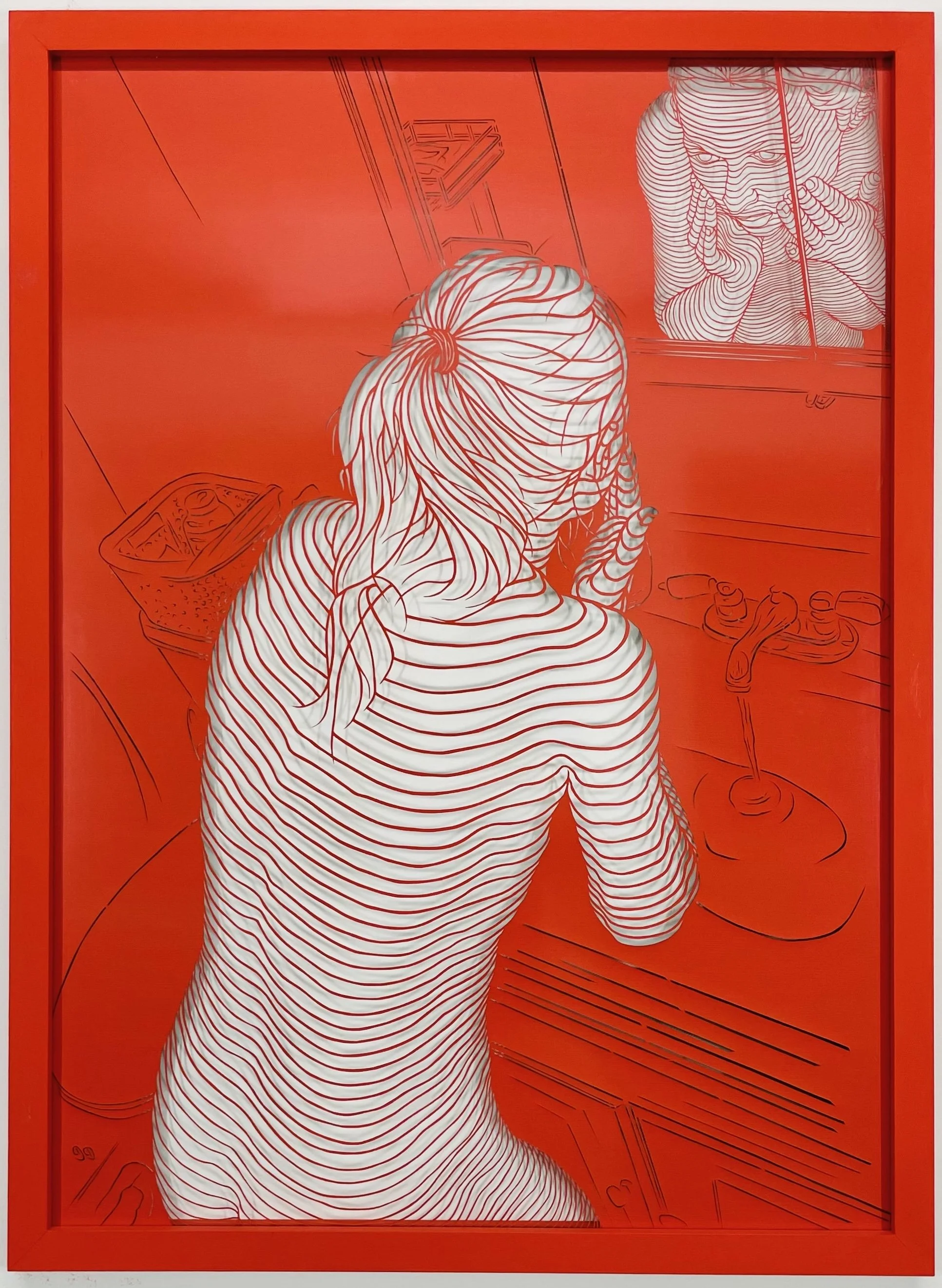
Justine's Bathroom, 2025 .Hand-cut paper, acrylic, wood frame, transparent supports, wall-mounted work 35 × 47 in. Courtesy of the artist.
Has art always been a major part of your life or did art arrive later?
Art has always been a major part of my life. It was actually even more central when I was a child than it is now.
I grew up in Eastern Europe, where cultural and sports education starts very early and is taken seriously. Because I showed an interest in both music and art from a young age, around four I was essentially given a choice between music school and art school. I chose art, and from then on it felt almost like a full-time occupation.
Did you continue with this technically demanding education?
I left home at fourteen to work in fashion, which completely changed the trajectory of my life. Fashion took me all over the world, and for more than a decade it became the main focus of my life. I was always making some kind of art on the side, but constantly moving made it difficult to maintain a serious practice. After several years in the United States, I gradually started finding my way back to art.
Portraiture has been around forever, yet your work doesn't feel interested in likeness as much as presence. Was there a moment when you realised that simply depicting someone wasn't enough, that you wanted to describe something less tangible?
I’m drawn to what makes a person more than their physical appearance, particularly the private worlds they create around themselves. The spaces we inhabit, the objects we live with, and the ways we arrange them become part of who we are, revealing a version of us that very few people get to see.
For a few years, I found it difficult to ask other people to pose for me, so I retreated into self-portraiture. I was willing to show my body, but not the space around it. Those early portraits were almost always figures floating in space, which gradually made me aware of how revealing an interior can be, and how deeply a sense of belonging to a place becomes part of a person’s identity.
What keeps me coming back to portraiture is everything that exists between a person and the idea we have of them. A portrait can never contain someone completely, and I don’t think it should try to. My portraits resist reducing people to a single identity. The person, the space, the objects, and the perspective all complicate one another, creating something that remains open to interpretation.
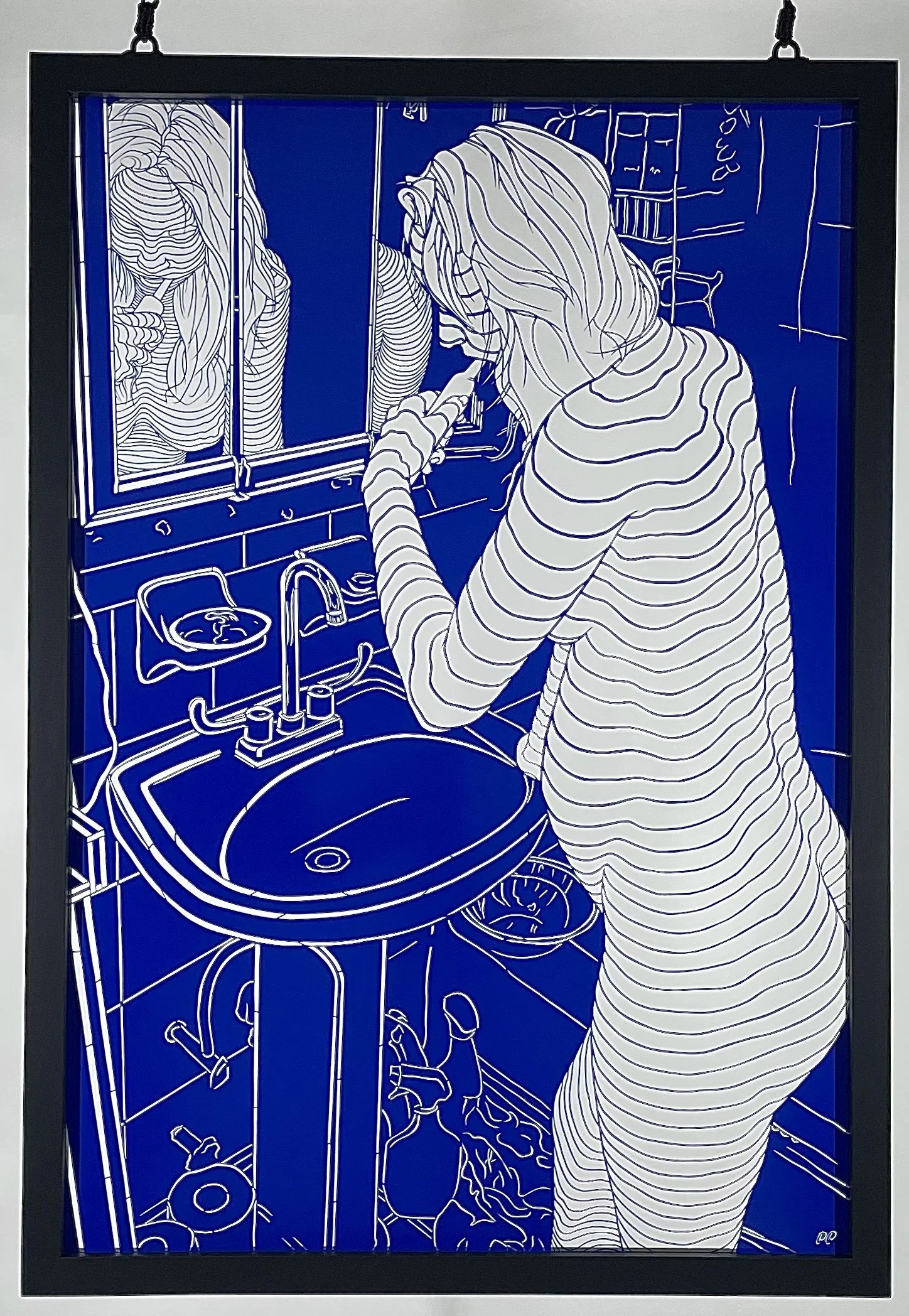
Mona's Bathroom, 2023. Hand-cut paper, acrylic, wood frame, steel stand, transparent supports, freestanding installation, 40 × 70 × 30 in. Courtesy of the artist.
You spend a remarkable amount of time getting to know the people you work with. I'm wondering if you've ever abandoned a project before it even began because the connection just wasn't there.
There isn’t a universal formula for how I make each work.
Sometimes I meet someone without knowing what I’m going to make. I don’t know what their body looks like, what their space will reveal, or what the composition will become. I don’t orchestrate the setting or direct what they do. I ask them to respond naturally to the moment, and the portrait becomes a collaboration between the two of us.
Other times, my mind assigns a person I know to a very specific portrait. I might have an image, an expression, or a structure in mind and somehow know that it has to be them. Then I just have to hope they agree.
I don't usually abandon a portrait because the connection wasn't there. I’m much more likely to abandon an image or idea for practical reasons. I used to photograph too many people at once, and eventually I would spend so much time looking at the images that I almost exhausted my relationship with them before I ever began making the work.
I imagine your process begins long before the camera comes out. Is there a conversation, a gesture, or even an awkward silence that suddenly tells you, “there it is, that’s what I’ve been looking for”?
There’s usually a conversation beforehand about what will happen when I arrive, but once I’m there, the process moves very quickly. So far, every portrait has been very natural and conversational. It’s not really a LIGHTS, CAMERA, ACTION! situation. We continue whatever conversation we started when I walked in, while I take one or two-minute videos of the person simply moving through their space. The shot is almost over before it feels like it has begun.
I choose the images from those videos afterward, and sometimes the moment I respond to has less to do with the perfect composition than with something the person said. Their words can become part of the portrait, and sometimes even the title. One work, Sarah’s Penis, came from a moment when Sarah turned toward me with a stuffed toy and jokingly said, “And this is my penis.” The image became the work because the moment itself felt inseparable from what she said.
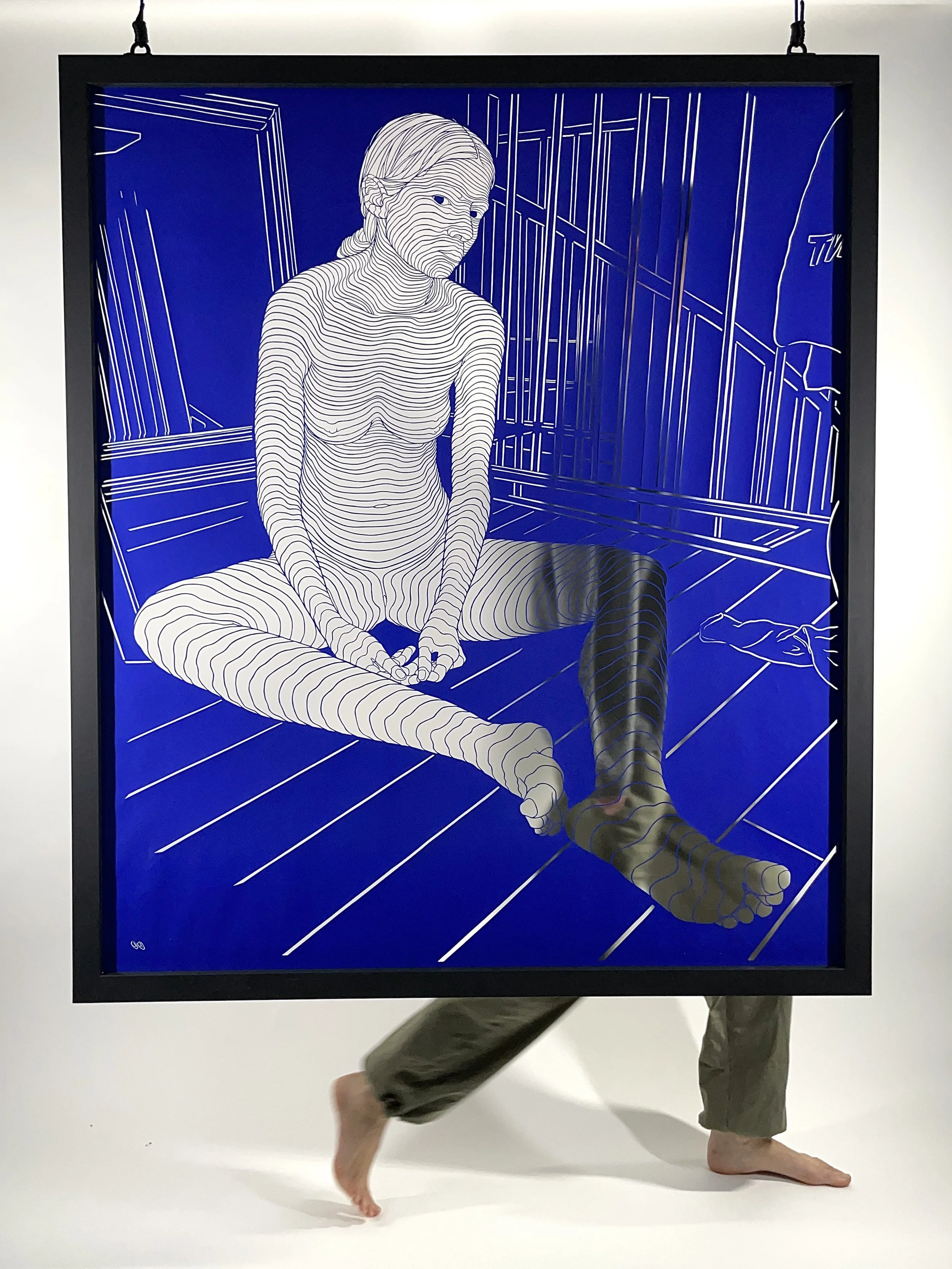
We Never Finished Our Conversation, 2022. Hand-cut paper, acrylic, wood frame, steel stand, transparent supports, freestanding installation, 44 × 51 in. Courtesy of the artist.
The people you portray are inseparable from the spaces they live in. Have you ever walked into a home that completely changed your understanding of the person who lived there?
When it’s a portrait of a stranger, rather than someone whose home I’ve seen before, walking through their door can feel like a beautifully overwhelming discovery of an entire world. Our spaces reveal so much about who we are, often in ways we don’t consciously recognise.
I don’t choreograph the environment, but I do ask people for one thing: please don’t clean before I come. I want to see the space as it exists when they are the only person living in it, with all of its disorder and traces of daily life intact. Personally, that would be incredibly difficult for me to offer that to a stranger. I would never let someone see my own home that way.
The thing I admire most in people is often the thing I can’t do myself. There’s something extraordinary about being invited into someone’s private world by a person you may have only just met. The objects they’ve chosen, the things they leave out, and the way they inhabit a room all become part of this unexpected encounter.
Do you ever feel like you're capturing a room that's pretending to be a person, or the other way around?
For me, home is quietly a place that holds a person together. The spaces we make for ourselves become part of how we understand ourselves, and where we locate a sense of belonging.
The interiors are central to the artwork, not simply because they give me something to look at, but because they establish a network of relationships. I think of architecture as a relational art, where meaning emerges through the connection between bodies, objects, light, and space. My interest in architectural drawing also gives me a way to push perspective beyond the ordinary, to create relationships that might not be visible from a conventional point of view.
The person shapes the space, and the space shapes the person. That exchange is where the boundaries between the individual and their surroundings begin to dissolve.
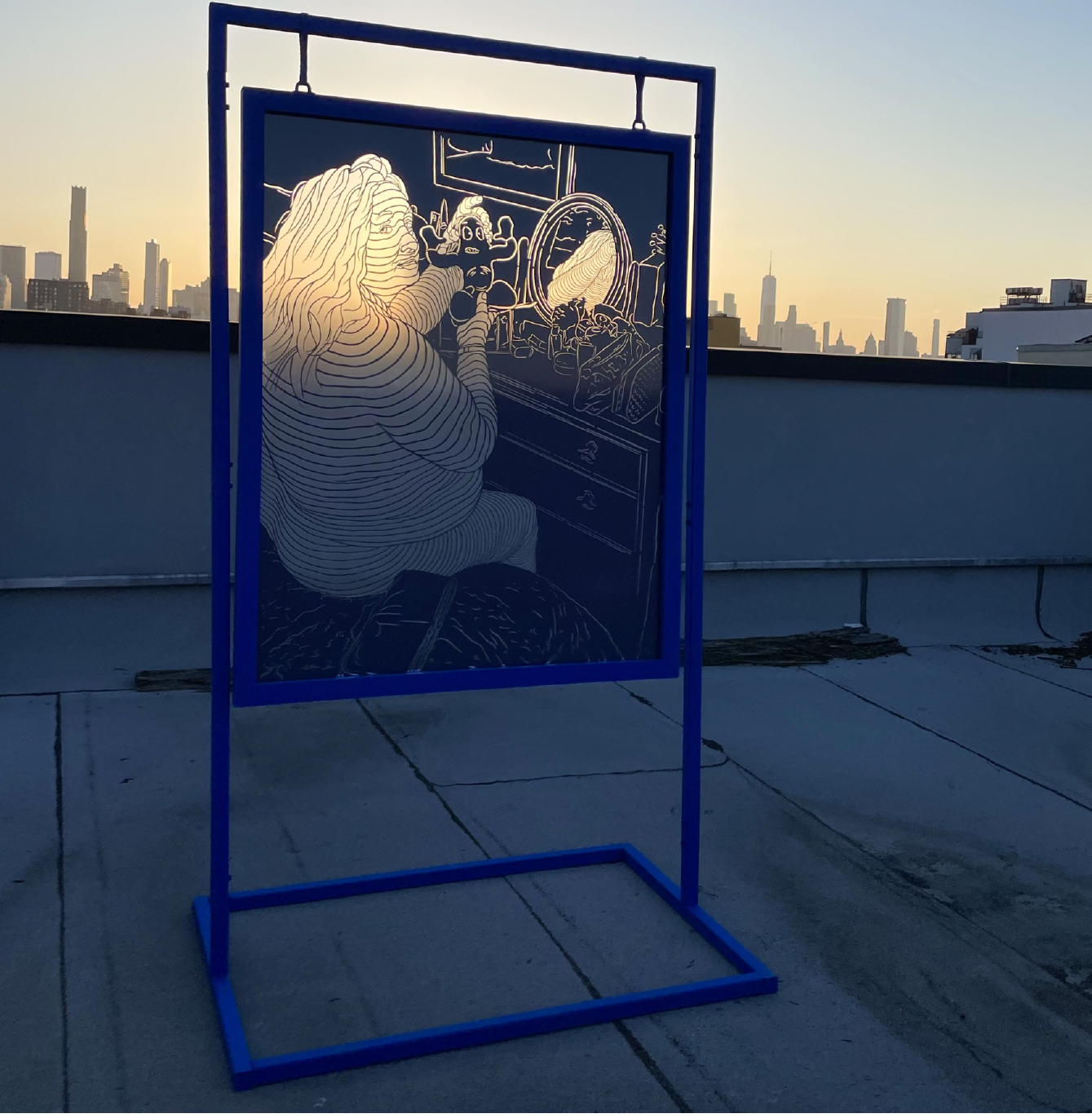
Sarah's Penis, 2024. Hand-cut paper, acrylic, wood frame, steel stand, transparent supports, freestanding installation, 40 × 70 × 30 in. Courtesy of the artist.
Do those moments surprise you while you're making them, or are you always steering toward that uncertainty of where one thing ends and another begins?
I think that uncertainty is actually a consequence of my commitment to depicting reality. My images are realistic in the sense that they are exact translations of moments I’ve captured. I don’t move a line or alter something because I think it would make the composition more convenient. If one body seems to merge with the wall or an object becomes almost indistinguishable from another, that is simply what happened in the original moment.
What is deliberate is figuring out how to make that reality exist as a physical object. I’ve spent years understanding what the material can and cannot do, and I genuinely enjoy those problems.
The more difficult the image is to construct, the more interesting the process becomes.
Your work asks people to slow down. Do you think that's something contemporary audiences have forgotten how to do, to really look?
I’m interested in making work that naturally rewards slowing down. The image withholds itself at first, asking the viewer to move through the work, approach it from different positions, and gradually discover what they’re looking at. The work becomes a kind of journey rather than something that can be absorbed in a single glance. I’m interested in that interval between encountering an image and fully apprehending it, and in creating an experience that remains with you after you’ve left.
I actually don’t think people have forgotten how to look. I think they’re craving opportunities to do it. Meaningful opportunities for sustained attention are relatively rare. It’s easy to make something that captures attention immediately, but much harder to create an image or experience that continues to unfold after that first encounter.
I wonder if making these portraits has changed the way you move through everyday life. Do you walk into restaurants, apartments, or subway cars differently now than you did ten years ago?
I’ve developed a somewhat journalistic way of looking. I notice spaces, the way people occupy them, strange relationships between objects, perspectives, gestures, and light. I can see the potential for an image almost anywhere, but I’m not consciously collecting things to turn into artworks.
I think what has changed is something much more subtle: what becomes visible to me. Even when I’m simply observing or documenting a space, there’s usually something more personal happening underneath. I might notice the relationship between a body and a doorway, the way someone has arranged objects around themselves, or how light changes the feeling of a room. I don’t necessarily think, “I need to make something from this.” Sometimes I just notice it and move on.
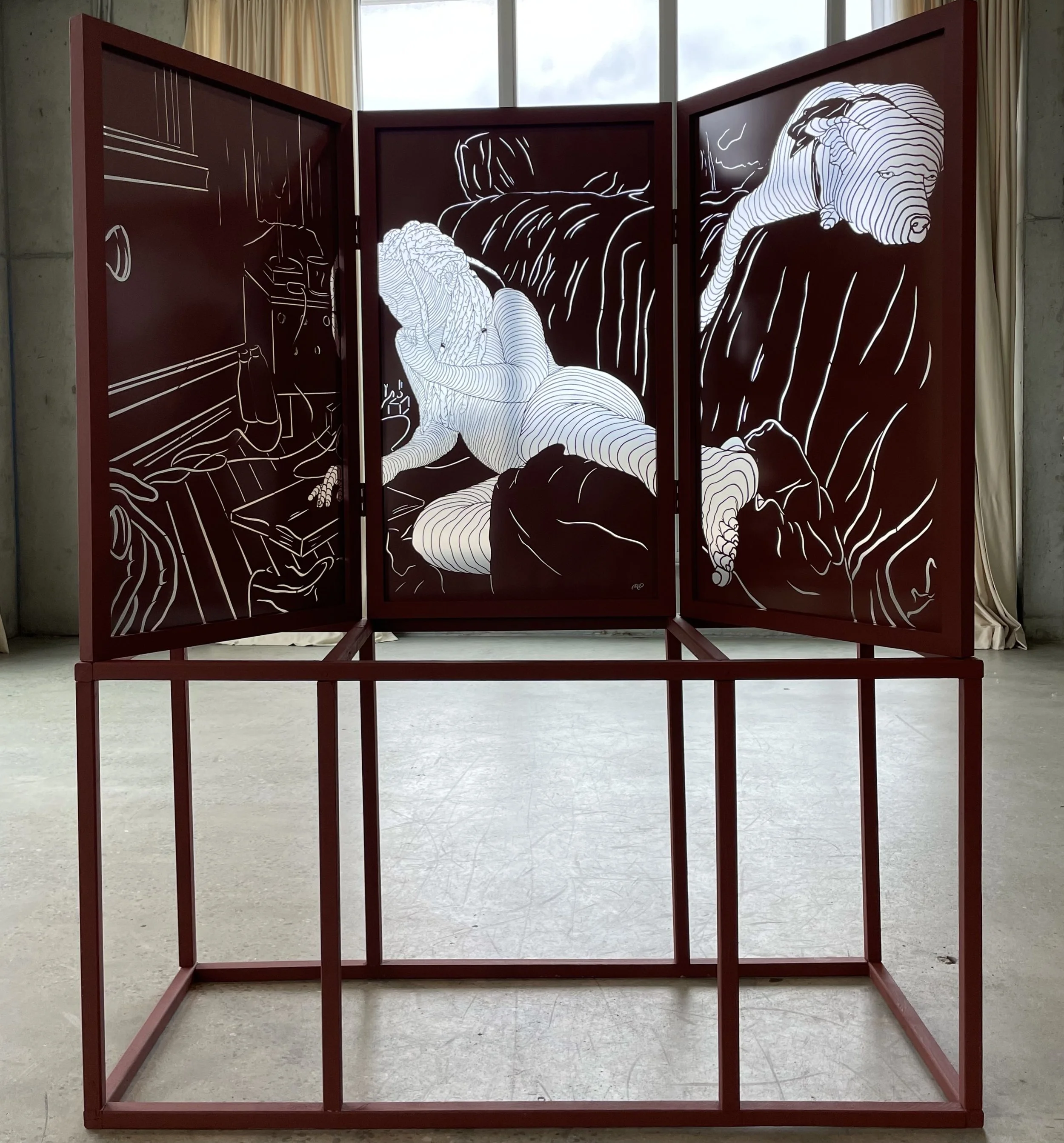
Crystal and Xhili, 2025. Hand-cut paper, acrylic paint, wood frames, wooden stand, transparent support panels, freestanding, triptych installation, 77 × 63 × 25 in. overall (H × W × D). Courtesy of the artist.
Your working seems built on paying close attention to other people. Has spending so much time observing others changed the way you understand yourself?
Portraiture became a way of understanding other people, but also a way of understanding myself. I don’t think we become visible to ourselves in isolation. We become visible through relationships, through the people we encounter and the perspectives they introduce us to. I accumulate ways of seeing and ways of thinking through those encounters, and each one changes how the next person becomes visible to me.
My work leave room for that complexity, for the space between what we think we know about someone and everything that remains unknowable. In that sense, observing others has become a form of self-observation. The more perspectives I encounter, the more my own perspective shifts.
When you imagine your work years from now, what feels exciting, not in terms of career, but in terms of what you still don't know how to make?
The work people see now feels like the beginning of a much larger idea. The direction I’m moving toward is work conceived for a particular place, where architecture becomes a device for looking rather than simply the container for the work.
An artwork doesn’t have to reveal itself immediately. It can become a sequence, a threshold, a delay. The viewer might have to enter, turn, climb, or move through darkness before the work reveals itself. That delay is doing part of the work. By the time you reach the image, the architecture has already prepared you to see it differently.
What excites me is that I don’t yet know exactly how to make those experiences. I’m studying architecture, engineering, fabrication, and spatial design because I want those disciplines to become part of my language. I’m searching for bridges between things that don’t necessarily belong together yet. For me, that uncertainty is where the work becomes interesting.
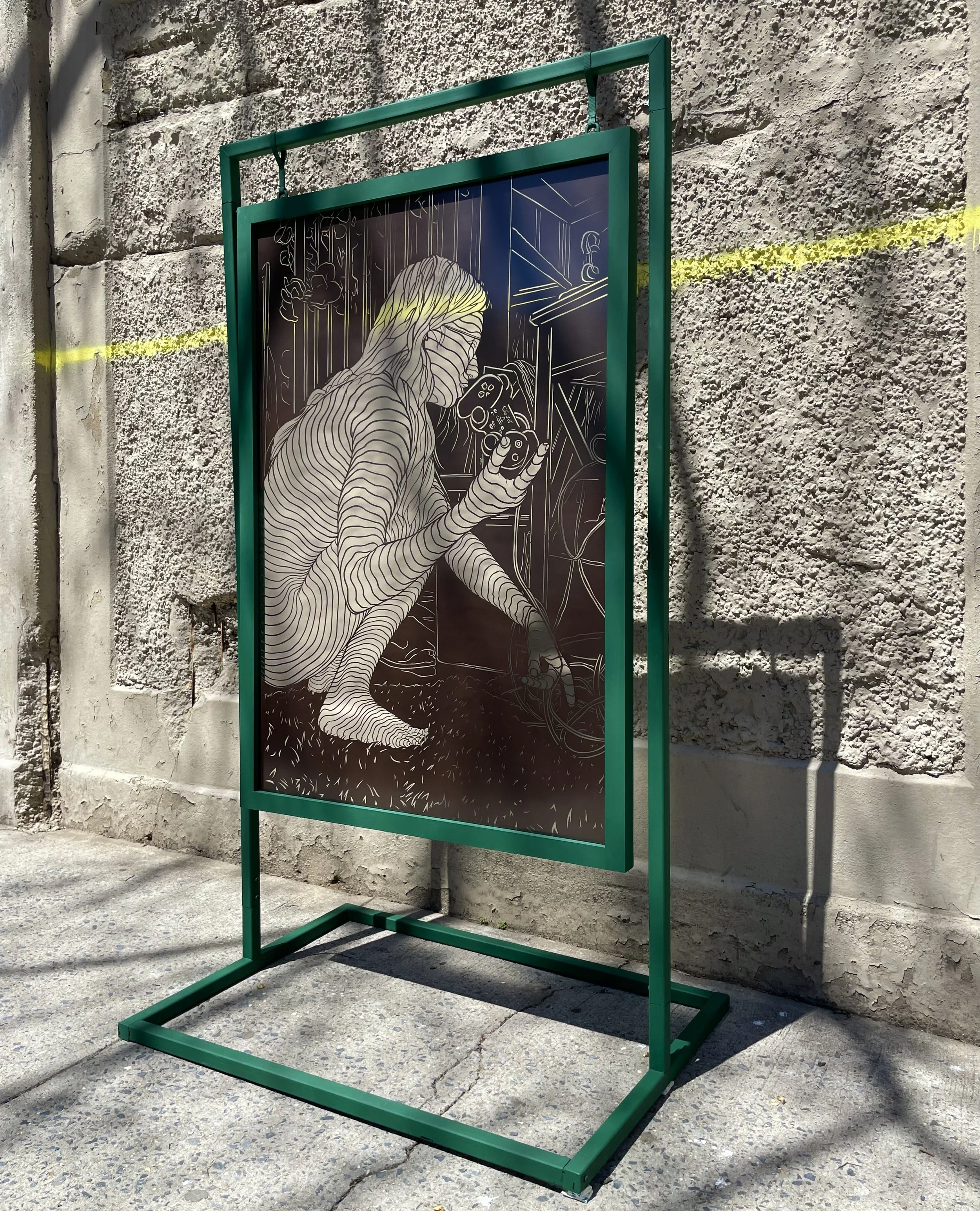
Leon's Living Room, 2024. Hand-cut paper, acrylic, wood frame, steel stand, transparent supports, freestanding installation, 40 × 70 × 30 in. Courtesy of the artist.
Now, looking back, are there experiences that didn't seem important at the time but now feel foundational to the way you see?
I think my classical education is shaping my art practice whether I like it or not. I'm naturally drawn to things that require mastery, especially when there are multiple kinds of mastery involved.
I have a tendency to choose the harder way, even when there is a perfectly reasonable shortcut. But for me, the difficulty is part of what makes the work interesting. If I found the easiest technical solution, I might solve the practical problem, but I would also remove the problem I was actually interested in investigating.
Working in fashion reinforced that in a completely different way. For almost twenty years, I was constantly put into situations where I had to figure out how to do something that seemed almost impossible, and then do it again the next day.
I think that relationship to difficulty will continue to drive the work, even as the materials, scale, and spaces change. I like confronting things that are beyond my ability because they give me something to figure out.
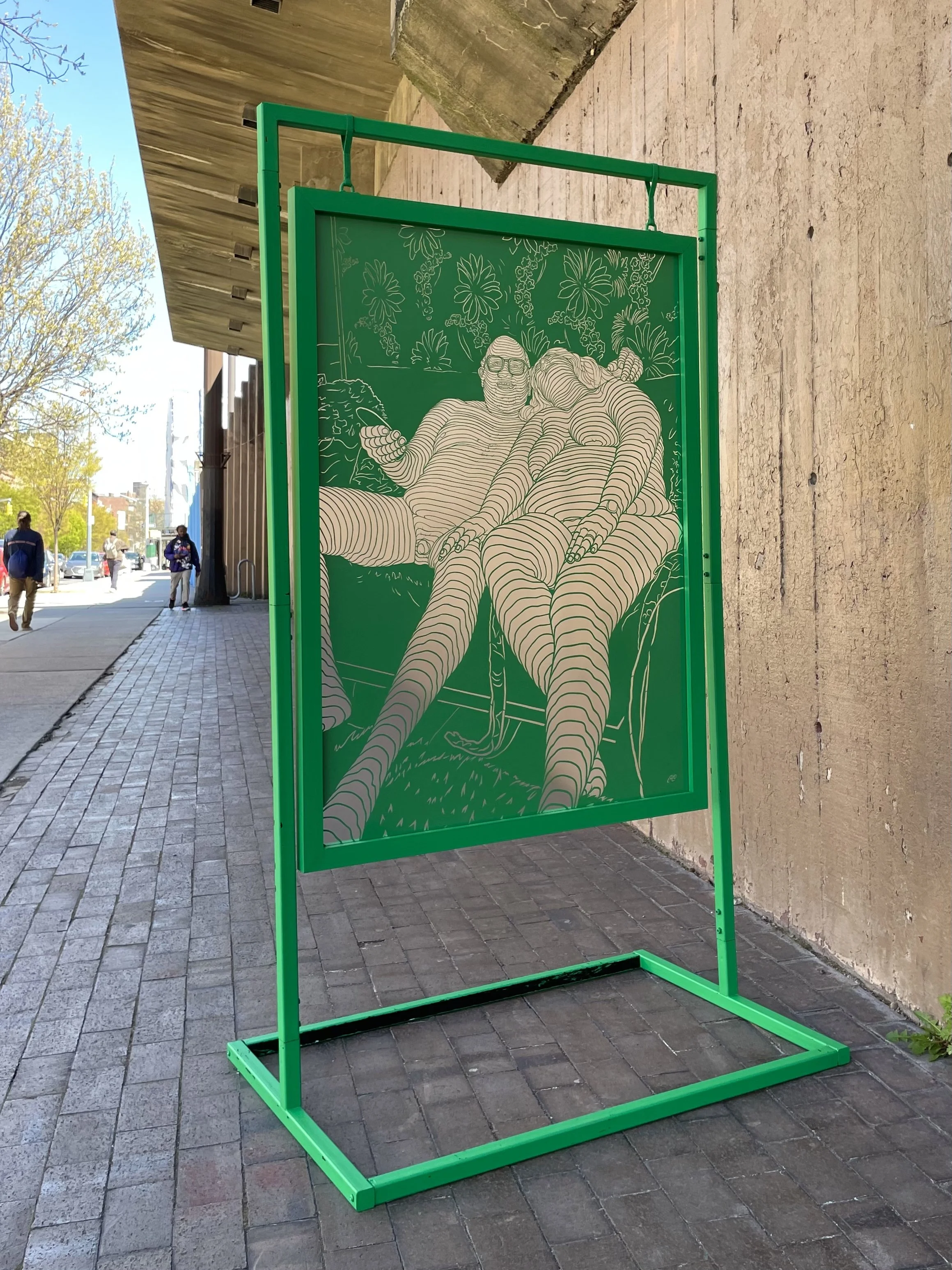
Sarah and Nat, 2024. Hand-cut paper, acrylic, wood frame, steel stand, transparent supports, freestanding installation, 40 × 70 × 30 in. Courtesy of the artist.