Alix Vernet talks to Phillip Edward Spradley
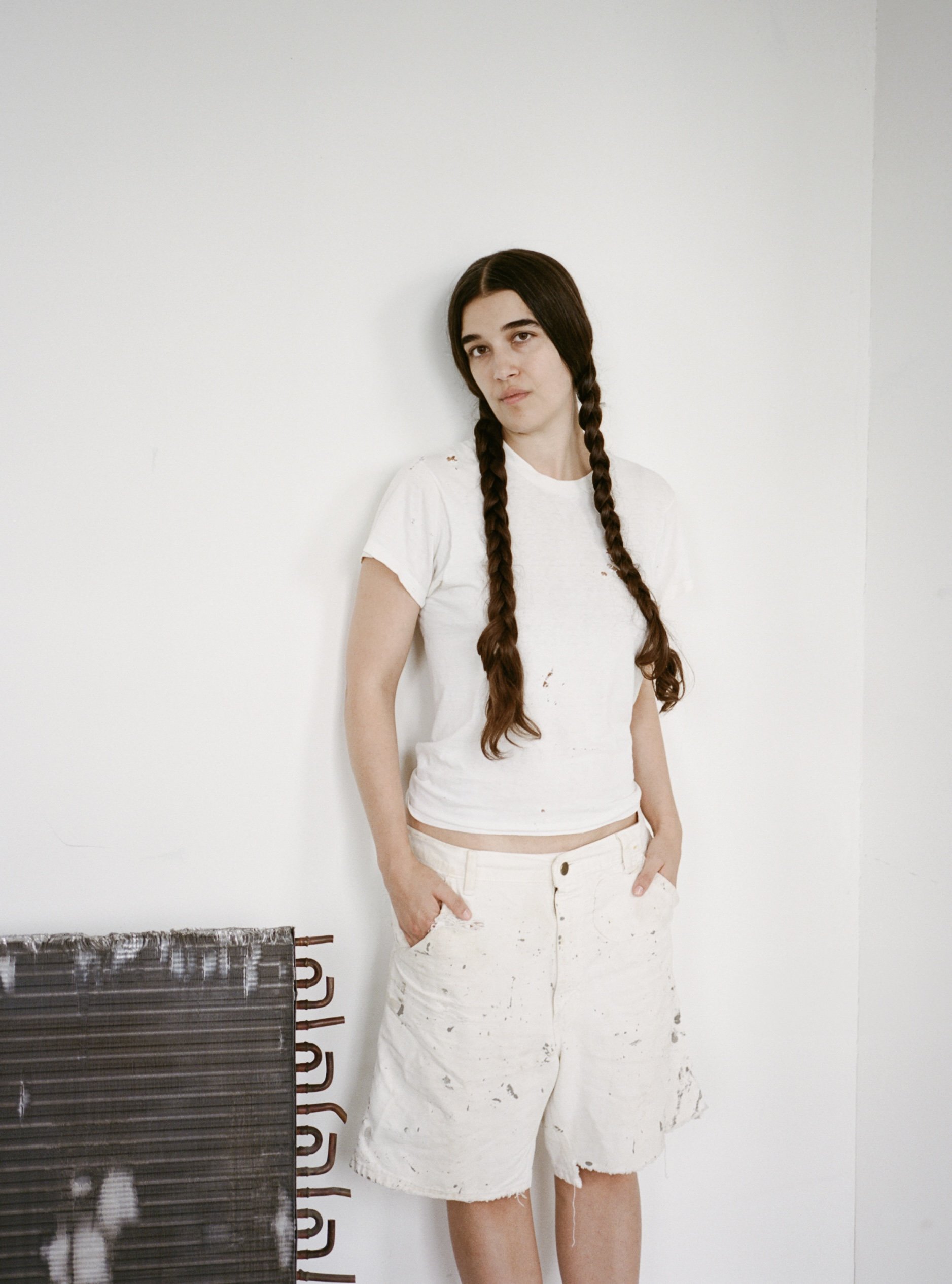
Portrait of Alix Vernet, 2026. Courtesy of the artist.
This conversation originally featured in BOMB Magazine, October 2026.
Few cities have shaped the language of contemporary sculpture as profoundly as New York. It is a place where architecture is continually repaired, dismantled, and rebuilt, leaving behind a landscape that appears permanent while remaining in constant negotiation. Its history does not reside solely in monuments or museums, but in the countless surfaces, trades, conversations, and acts of maintenance that allow the city to endure. Cornices weather, storefronts disappear, sidewalks crack, and generations of labor quietly accumulate within the built environment, making the city itself a living archive.
For Alix Vernet, sculpture begins long before an object enters the studio. Her practice unfolds through walking, conversation, and sustained attention to the overlooked systems that hold a city together. Rather than beginning with archives, she follows relationships—allowing chance encounters with monument conservators, scrap dealers, neighborhood shopkeepers, and skilled tradespeople to shape her understanding of the place. Research, for Vernet, is built through trust, reciprocity, and time.
This fundamentally shifts the role of casting within her work. Architectural fragments, air conditioners, utility covers, and decorative reliefs are never simply reproduced for their formal qualities. Instead, they become records of encounters, carrying the imprint of forgotten trades, local knowledge, and the people whose lives remain embedded within the city's fabric. Her sculptures are less documents of New York than evidence of the relationships through which it is continually understood and remade.
Although Vernet's work is deeply invested in urban change, it resists nostalgia. She is less concerned with preserving the past than with asking what forms of attention might still be possible within a city in constant transformation. Her sculptures invite us to look beyond the object itself and toward the networks of people, memory, and exchange that give it meaning, reminding us that the most enduring histories are often carried not by monuments, but through everyday encounters and the willingness to slow down long enough to notice.

CROWDS, After N.H Pritchard “crowds” from EECCHHOOEESS, 1971, 2023. Glazed stoneware. Letters from facade of Brooklyn Public Library, Grand Army Plaza. 144 x 138 in (365.8 x 350.5 cm). Courtesy of the artist and Chapter NY.
Phillip Edward Spradley: I have this feeling that little Alix Vernet was probably just as observant as the adult version. If we had met on a playground, I imagine us off to the side looking at cracks in the pavement or trying to understand why something looked the way it did. I don’t know if that’s true or if I’ve completely invented your childhood.
Alix Vernet: (laughter) I wish I could tell you I was that quiet kid studying cracks in the sidewalk, but I really wasn’t. One of my earliest memories is taking off all my clothes and streaking across the schoolyard because I wanted to know what it felt like. These girls were sent to chase me down.
(laughter) That’s the opposite of what I imagined! Maybe what I was getting at wasn’t whether you were quiet, but whether that impulse to observe was already there.
I was definitely curious, but it was always very action-based. If I had an impulse, I usually followed it before thinking too hard about whether it was a good idea. Looking back, people might have described that as adventurous if I had been a boy. Instead, it was more like, You’re a strange, badly behaved girl. I was living in my imagination, and that would get me into trouble.
I moved eleven times by the time I was sixteen. I don’t necessarily remember leaving places—it was too sad—but I remember arriving. Moving that frequently changes how you relate to the world. You’re made up of all these fragments of places. I had to get used to being the new kid. I often felt behind, like I had to catch up to all these lives I had missed out on.
I can see how that might have informed your interest in histories tied to specific sites. You have some French roots. What was growing up in France like?
One village I lived in was a place where Joan of Arc passed through and had visions from the angels. There were statues of her everywhere. As a lesbian, I have a cautionary relationship to Catholicism. My dad is French and comes from a deeply Catholic family; my mom is a New York Jew who was formerly in a Bay Area dyke band called Mudwimin, so she balanced things. I do think the atmosphere of sacredness affected me in a generative way because it gave ordinary places a sense of veneration, as though something had happened there that wasn’t immediately visible.

Window to the City, St Marks, 2023-26, Glazed stoneware 68 x 43 1/2 x 7 in (172.7 x 110.5 x 17.8 cm). Photo by Charles Benton. Courtesy of the artist and Chapter NY.
Your work carries that same feeling. Nothing is ever only an air conditioner or a facade. There is always a sense that something has accumulated there.
I’m interested in places that hold more than one story. That probably comes from moving around and knowing how many different lives can happen in the same space. You leave, someone else moves in, and the place continues without you. My work moves between being close enough to see what happens over time, but maintaining enough distance to remain surprised. I also realized recently that addresses are ingrained in me. I remember almost every address I’ve lived at, which is funny because so many of my works are titled after addresses.
The address catalogs a time and place, which is also what the sculpture is doing physically.
Exactly. My middle name, Delancey, is actually after an address because that’s the street where my mom got pregnant. She claimed it as a kind of landmark. That play between language, site, and memory comes back throughout my practice.
When did art become the thing that could hold those experiences together?
I’m not sure there was a singular moment, but in high school I realized that if I could make meaning or create something beautiful from experiences that seemed unanswerable or out of my control, I felt better.
Now you have a studio in Chinatown that seems to have arrived through a very New York kind of accident.
Completely. My partner meant to text our mutual friend but accidentally texted a superintendent of a building, and he replied, “We have a unit available.” I really think Chinatown is a site of small miracles. It’s close to the scrapyard where I get materials and the Chinese bakery that my friend own and helps me translate and find parts. In exchange, I find him leather bags online. My work is reliant on a network of people in the city and a mutual exchange system. A friendship with a stranger at the bakery is a more valuable resource to me than, like, an art supply store.

Lady, Saint Marks, November, 2021. Cheesecloth, latex, spray paint. 54 x 13 in (137.16 x 33 cm). Courtesy of the artist and Chapter NY.
Your research seems to begin with people rather than objects.
I think that’s true. Years ago, I met someone who worked for the New York City Parks Department. His job was essentially to maintain monuments around the city and remove graffiti from them. He invited me to meet him while he was cleaning the Washington Square Arch.
And the conversation became a larger project.
Yes. I ended up doing that for almost a year. He would call and say, “We’re going to Flushing today to take the mortar out of a World War I memorial angel,” and I would go meet him. I learned about monuments through maintaining them: removing moss, cleaning graffiti, replacing mortar, how the public interacted with them. It became one of my first shows in New York: City, When Will You Keep Your Promise?
Which brought you directly into the tension between vandalism and conservation.
Yes, I kept thinking, If making a mark in public space is considered vandalism, what is the opposite of that? Is removing the mark actually more damaging? That friction interested me. His job involved using touch to remove marks and restore an official surface, while I was thinking about how I could use touch to make another kind of impression and reauthor an official voice.
When does something stop being a record of what you encountered and become its own sculpture?
With silicone mold-making, there’s always the possibility of creating a replica. Over time, it became clear I was more interested in preserving a moment than creating a perfect imitation. My clay impressions, for example, reflect an encounter: how much time I had, what I could physically reach, who was around, whether something interrupted me. All of that shapes the object. Further along, I realized I could gather letters and create something closer to an alphabet from monuments around the city, but those alphabets could never be complete because they were limited to whatever letters already existed on the facades.
So the architecture sets the terms of speech. Does that approach extend to your works with air-conditioner parts?
I’d say pressure ties those works together as both involve touch. I started working on those after I had noticed a handprint pressed into an air conditioner in the city. To produce marks, you press directly into the metal fins with your fingers. Language is shaped by movement in a similar way to my previous work.
Where do the words you add come from?
It’s all tied to the street. I have a word bank of things I walk past. My long-time partner in crime, Nico Lou, has been joining me on these walks. We found something scrawled into cement that said, “boys holding hands.” It’s already gone now. That kind of thing enters the bank. A civic monument has an official, governmental voice. Hand-painted signs are almost the opposite. They’re specific to a neighborhood. The lettering and language change depending on who lives there and who learned from whom.
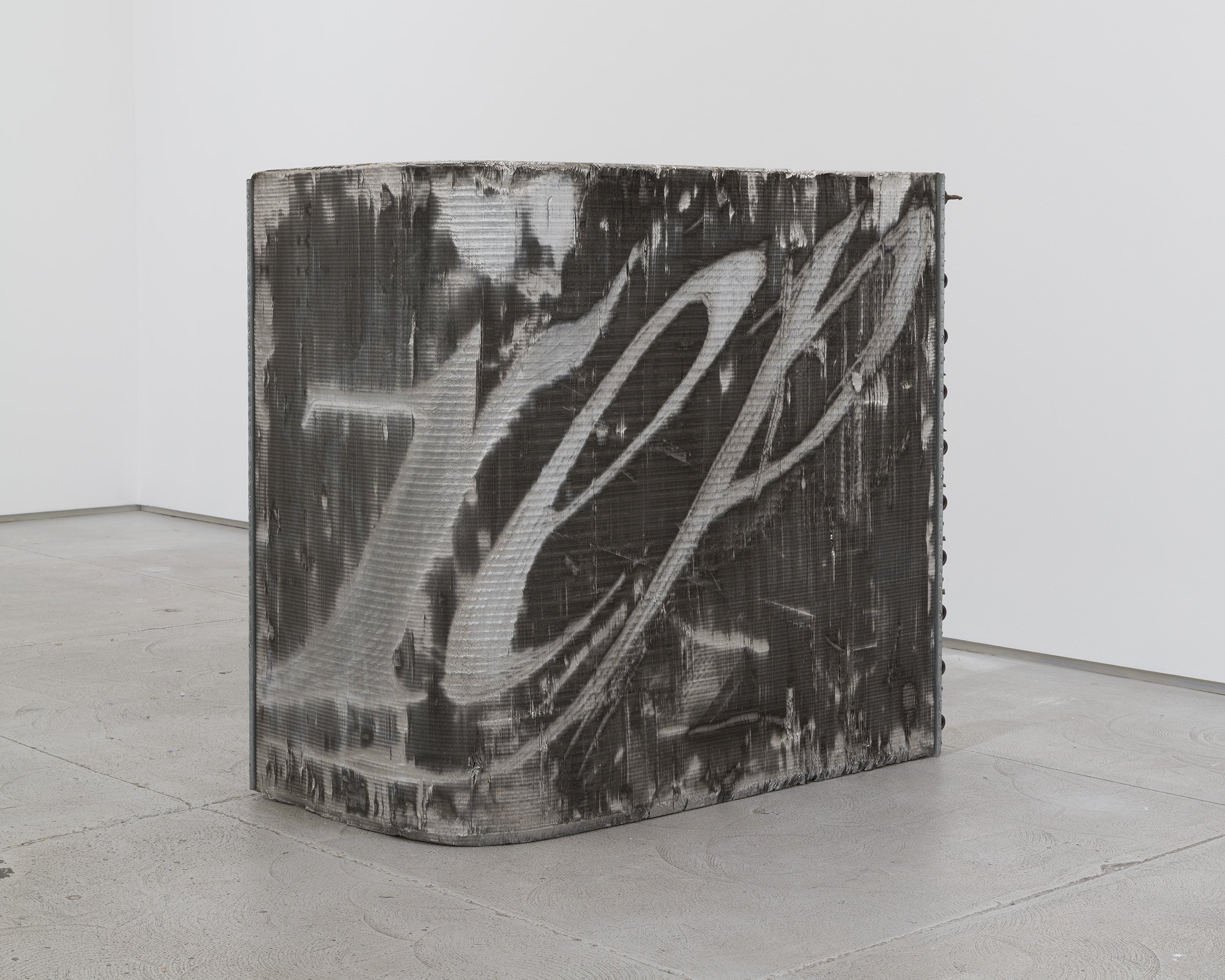
Installation view, LANDMARKS, 2026. Photo by Charles Benton. Courtesy of the artist and Chapter NY.
You’re interested in what people have stopped seeing. Is that why nostalgia feels like the wrong word?
I think so. I’m interested in how the many uses, transgressions, and lives contained within one site or object can reveal possibilities for the current moment. I want to pay attention to what we are leaving behind in this culture of accelerationism. Making things faster usually means avoiding talking or dealing with people, but that’s what makes things interesting!
Mourning doesn’t seem to be where you want it to end.
Definitely. There are artists, stories, and ways of knowing that should remain part of how we look to the future. I don’t want the work to become a swan song for loss. There is melancholy in it, and sometimes it can act like a memorial, but I want it to be more of a reminder.
It feels fitting that we began with you as a child wanting to know what something felt like, and now we’re ending with touch as a way of understanding the city.
(laughter) That is funny. Maybe that part hasn’t changed. I still want to know what something feels like, and then I usually have to go touch it and find out.
PES: When did art become the thing that could hold those experiences together?
AV: I’m not sure if there was a singular moment but I remember that in high school, I realized that if I could make meaning or create something from experiences that felt intolerable, or unanswerable I felt better.
PES: Now you have a studio in Chinatown that seems to have arrived through a very New York kind of accident.
AV: Totally. My partner accidentally texted the superintendent of a building and he replied, “We have a unit available.” The room had basically sat empty to store tax documents for thirty years. Though I have been making work on fire escapes in the area for a long time, it's the first studio I’ve had in the city. It’s close to the scrap yard where I get materials and the Chinese bakery, my friend owns and helps me translate & find parts. He is really into vintage leather so in exchange for his help, I find him deadstock leather goods on Etsy Ebay, etc... Overall my work is reliant on this network of people in the city and we have a kind of mutual exchange system. This friendship with a stranger at the bakery for example has become such an invaluable resource to my practice.
PES: Your research seems to begin with people rather than objects.
AV: I think that’s true. That approach became clearer in 2020 when I started working with a monument technician. I realized chance conversations were the most important resource to my practice.
PES: It sounds as though you’ve shaped the practice to keep yourself from becoming isolated.
AV: I have. I often leave conversations thinking that maybe the sculpture isn’t even the most important part.
PES: That’s a remarkable thing for a sculptor to say.
AV: (Laughs.) I know, but I mean it. The object becomes evidence that all these other things happened. It reminds me that I spent time with this person or learned a particular way of looking at something.
PES: How did you begin working with the monument technician?
AV: It came after I had a pretty sobering experience my friend Nico and I had wheatpasting art downtown senior year of high school. I became terrified of doing something like that again. I realized I needed to rethink my approach. I met someone who worked for the New York City Parks Department in 2020. His job was essentially to maintain monuments around the city and remove graffiti from them. He invited me to meet him while he was cleaning the Washington Square Arch. At first, I thought it would be a one-time conversation that might inform the work I wanted to make around tenement architecture.
PES: And the conversation became a larger project.
AV: Yes I ended up doing that for almost a year. He would call and say something like, “We’re going to Flushing today to take the mortar out of this WW1 angel.” Then I would go meet him. I learned about monuments through the actual process of maintaining them: removing moss, cleaning graffiti, repairing mortar, and deciding what belonged to the surface and what needed to be taken away. It became one of my first shows in New York ‘City When Will You Keep Your Promise”.
PES: Which brought you directly into the tension between vandalism and conservation.
AV: Yes. I kept thinking, If making a mark in public space is considered vandalism, what is the opposite of that? Is removing the mark automatically conservation? I became interested in the friction between those two categories. They weren’t as separate as they initially appeared. His job involved removing certain marks and restoring an official surface, while I was thinking about how I might touch that same architecture and make another kind of impression. That tension continues to come up throughout my work.
PES: The fragment gave you access to the monument without pretending you could possess or reproduce the whole thing.
AV: Exactly. I wanted to find a way to collapse the idea of monumentality, by evidence of contact rather than scale. That experience led into the language works. I began pressing clay into letters and pieces of language on civic architecture. Sometimes I was working between cleaning cycles. He would let me make an impression, and then the surface would eventually be power-washed or maintained again.
PES: So the work wasn’t only borrowing the monument’s surface. It was entering its maintenance schedule.
AV: Yes. That was really important. Following him around allowed me to see that a monument wasn’t a static historical object. It was something continually produced through maintenance.

Grand Army Plaza, 2021. Courtesy of the artist and Chapter NY.
PES: When does something stop being a record of what you encountered and become its own sculpture?
AV: With silicone mold making, there’s always this possibility of creating a replica. Over time, it became clear that I was not really interested in making a perfect imitation, but in documenting a moment. My impressions of sites are reflective of an encounter: the conditions of making it are always there, how much time I had, what I could physically reach, who was around, and whether something interrupted me. All of that shapes the object.
My early direct press mold clay pieces on monuments were born from limitation.I might have only a certain amount of time to press clay against a building and take a word. The rarity of the word, and the amount of time I had to get it, became part of the poetics of the work.
PES: The architecture sets the terms of speech.
AV: Right, and the site has to push back a little bit. There was a point where I realized I could gather more letters and create something closer to an alphabet or font matrix from different monuments around the city– but those alphabets could never be complete because they were limited to whatever letters already existed on the façades. The building determined what language was available to me.
PES: The work slows language down.
AV: Yeah. With the air conditioners, language became physical in another way. You press directly into the metal fins with your fingers to make the letters. I think pressure ties those works to the casts. Both involve touch. It has a capacity for inscription but it’s also an index. I had started noticing writing and handprints already pressed into discarded air conditioners. There was evidence that somebody had touched them, leaned against them, or scratched something into the fins.
PES: Where is that attention taking you now?
AV: I’m preparing my first solo exhibition with Chapter, called LANDMARKS, which will be a large sculptural installation of pieces I’ve been making from repurposed air-conditioning condensers. I’m excited because it’s the first time those works will really be shown together as a body. It’s kind of a play on words, the idea of a ‘landmark’ has obviously been something that has come up across my past bodies of work in different ways. Ironically, though landmarks are often sites of activity they can become kind of untouchable. The air conditioners sit within that space. They already have histories before I find them. They’ve been installed in someone’s home, exchanged their air, been exposed to the street, touched, repaired, dented, and eventually discarded. Then I add another mark. People tag AC’s all the time with keys, but I actually formulated my approach of stenciling letters on the AC’s after consulting this stone carver who works on memorials, so again it’s a kind of blend of techniques from traditions that are seen as opposites.
To learn more about Alix Vernet visit her website and Instagram