Veronica Fernandez talks to Phillip Edward Spradley
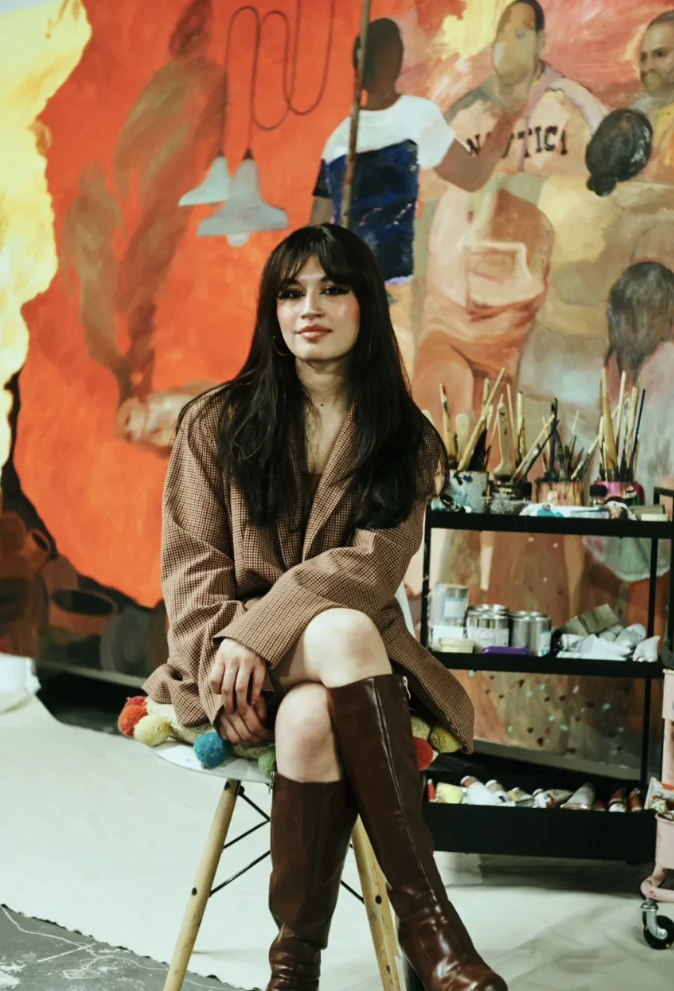
Portrait of Veronica Fernandez. Courtesy of the artist.
The rooms that shape us are often transient, overlooked, or quietly marked by absence. They can hold tenderness and care, but also instability, uncertainty, and the kind of precarity that society sometimes prefers not to see. It is within this charged, often taboo terrain that Veronica Fernandez’s visual language takes shape. Her paintings inhabit spaces that hold us briefly, tracing the emotional residue of interiors that exist at the margins of security and comfort.
Fernandez draws from an upbringing marked by frequent moves and periods of housing precarity across multiple states. Her work navigates the psychological landscape of houselessness, family memory, and domestic instability, transforming recollection into layered figurative compositions that hover between clarity and distortion. Rather than avoiding the discomfort of these realities, she confronts them directly, reconstructing motels, temporary bedrooms, and shared interiors through a process that filters lived experience through imagination. Memory becomes both subject and material in her hands, stretched across saturated color, shifting perspective, and scenes that feel at once intimate, tender, and unsettled—spaces that remember more than we often do.
Color and surface play a central role in conveying this emotional complexity. Fernandez employs saturated hues, unexpected tonal shifts, and layered textures that suggest both intimacy and unease. Architectural elements bend subtly, proportions shift, and backgrounds dissolve into gestural passages, mirroring the instability of memory itself. In this way, physical space becomes inseparable from emotional state. Her brushwork oscillates between controlled figuration and looser abstraction, reinforcing the sense that these are spaces reconstructed from within rather than observed from afar.
The ambiguity in Fernandez’s compositions invites viewers to enter through their own memories of home, however stable or unstable those may be. Specific enough to feel intimate yet open enough to avoid strict narrative closure, her paintings resist fixed interpretation. They do not position houselessness as spectacle or sociological case study; instead, they center interiority—how it feels to grow up in flux, how love and uncertainty coexist within confined spaces, how memory reshapes hardship into something both painful and poetic.
Through this interplay of figuration and abstraction, personal history and collective resonance, Fernandez constructs paintings that function as emotional architectures. Her work suggests that “home” is not solely a physical structure but a psychological condition—one formed as much by attachment and memory as by permanence. In reframing domestic instability as a site of complexity rather than deficit, she offers a body of work that is at once deeply personal and quietly expansive.
Fernandez earned her BFA from The School of Visual Arts in New York. She has exhibited internationally, with solo and group shows at Pippy Houldsworth Gallery, London; Galleria Poggiali, Milan; Loyal Gallery, John Doe Gallery, and Night Gallery in Los Angeles; and Thierry Goldberg, New York. Her work is included in the permanent collections of the Columbus Museum of Art, Columbus, OH; Institute of Contemporary Art, Miami; Pond Society, Shanghai; and X Museum, Beijing.
Fernandez’s upcoming solo exhibition Prey at Anat Ebgi, Los Angeles, opens on February 21, 2026, and runs through April 4, 2026.
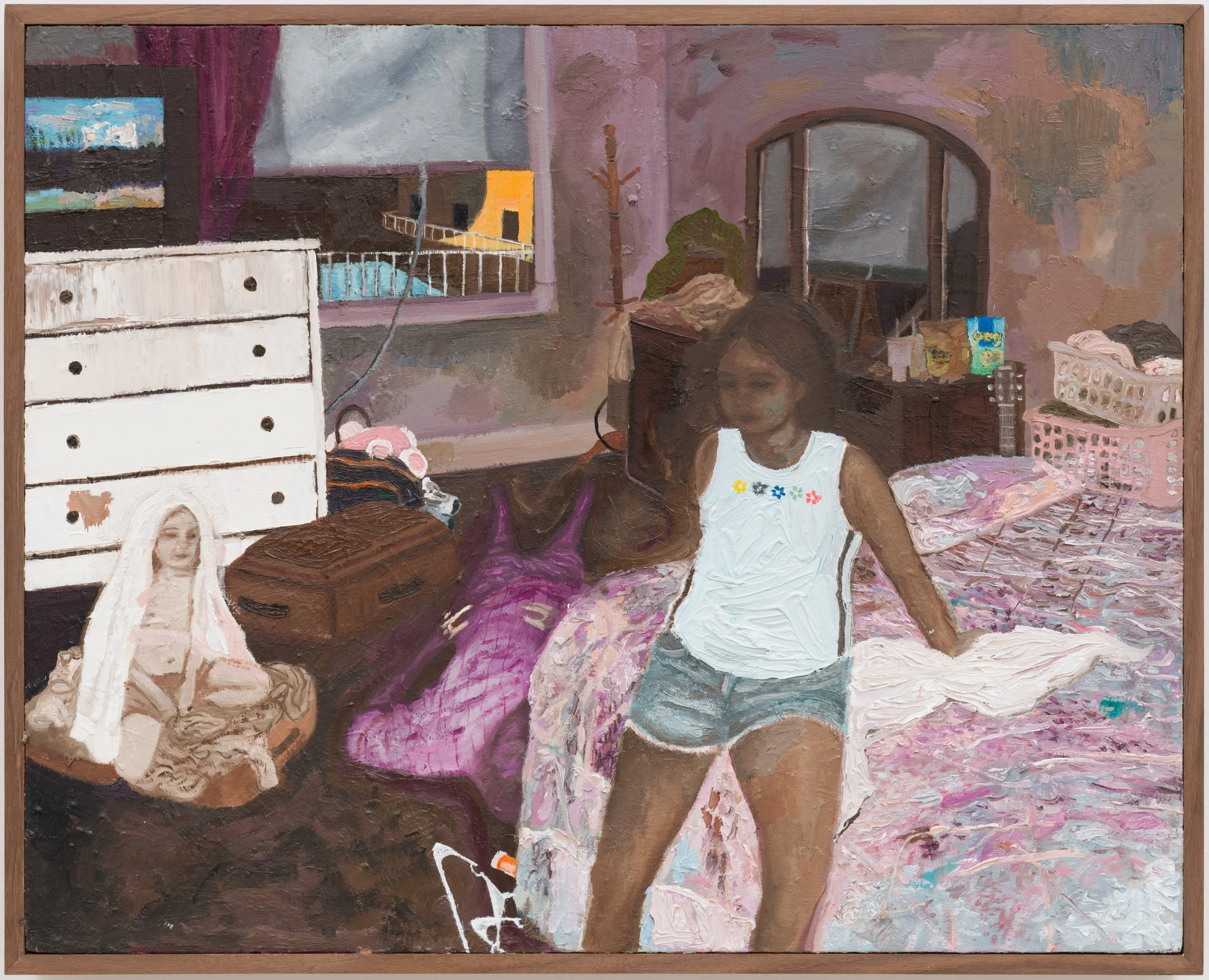
Next to Shower Here, 2026. Oil on panel. Framed 16 3 ⁄ 4 " x 20 3 ⁄ 4 " x 2 1 ⁄ 4 inches. Courtesy of artist.
Phillip Edward Spradley: Can you speak about the genesis of the exhibition title? Was it a starting point that shaped the direction of the work from the outset, or did it emerge more gradually through the process of making the paintings?
Veronica Fernandez: The exhibition title was formed back in 2023, around summertime. I had been working in saturated pinks, reds, and yellows, thinking about changing my palette a bit and trying out something new. At the time I had a lot going on, both physically and mentally. I couldn't focus as well as I would have liked to on my paintings. I had done a few projects before and felt a little drained in general. So I turned to drawing, poetry, and reading in the studio a lot more than to painting, which is generally how I'm eventually able to get all my energy back onto the canvas.
At the time I remember reading “I Paint What I Want To See” By Philip Guston, and reading
about these exploratory quick drawings he had done. Out of curiosity, I would spend a few weeks putting on some music or TV shows and working on quick gestural drawings as well. This exercise eventually led to me having a wall covered in brown, white, gray and orange toned papers from ceiling to floor. Some had been in charcoal, some in white and black colored pencil or soft pastels. The process of making these drawings was spending a minute or two scribbling lines and making spiral-like gestures then pinning them onto the wall.
Many of the drawings looked like black tornadoes, white mountains or cloudy blocks of color. A lot of the time I was thinking, honestly, what the hell am I doing? Regardless, it felt fun and eventually I found myself incorporating some figures that looked like they were balancing or moving around on pedestals or floating rocks in these open mysterious mountain worlds. The figures were running and jumping off these platforms, balancing poses on them. Some of the figures were being thrown off by other figures, falling on one another in ways that felt more violent and impulsive.
From these ambiguous drawings I wrote a poem called “I Want to Fly.” This poem the past year and a half has impacted a lot of the works I have made, I even found myself including some lines into other shows or into titles of pieces.
“I Want to Fly”
Among all things
One thing always asked of me was to pray
Because to pray meant someone could hear me
It meant i could be closer to power
So when darkness came i fell to my knees
But as my eyes shut I could only imagine the dry wall in front of me
And it came closer to me until i suffocated
Pieces splintering into my gums, my face pressed against all that is behind it until
Everything bleeds brown
And when i open my eyes, there it is in front of me
But im here and my heart is beating fast, so fast
Maybe prayer didn’t want me, it knew i had hurt myself
It knew i wanted control
It knew I wasn't pure
That i had and always have been a coward
I should have prayed for other people
The figures in the drawings, these endless possibilities of paths, I started to feel like they were speaking as some sort of place of escape. There was this sort of urgency that formed a thread from the poem into the drawings, an anxiety that served as a catalyst for the body of work. “I Want to Fly” came from the anxieties I had around myself, everyone and everything I witnessed around me. I was struggling to feel connected and to feel present. Part of me felt maybe that there was someone who was also sitting with this feeling, somewhere in a locked room staring at the wall in front of them just like me.
Eventually I wrote in colored pencil “PREY” on my studio wall over all the drawings. I knew whatever paintings came from this work, there was going to be this element of vulnerability, maybe something that the figures would be running from or made to feel powerless against.
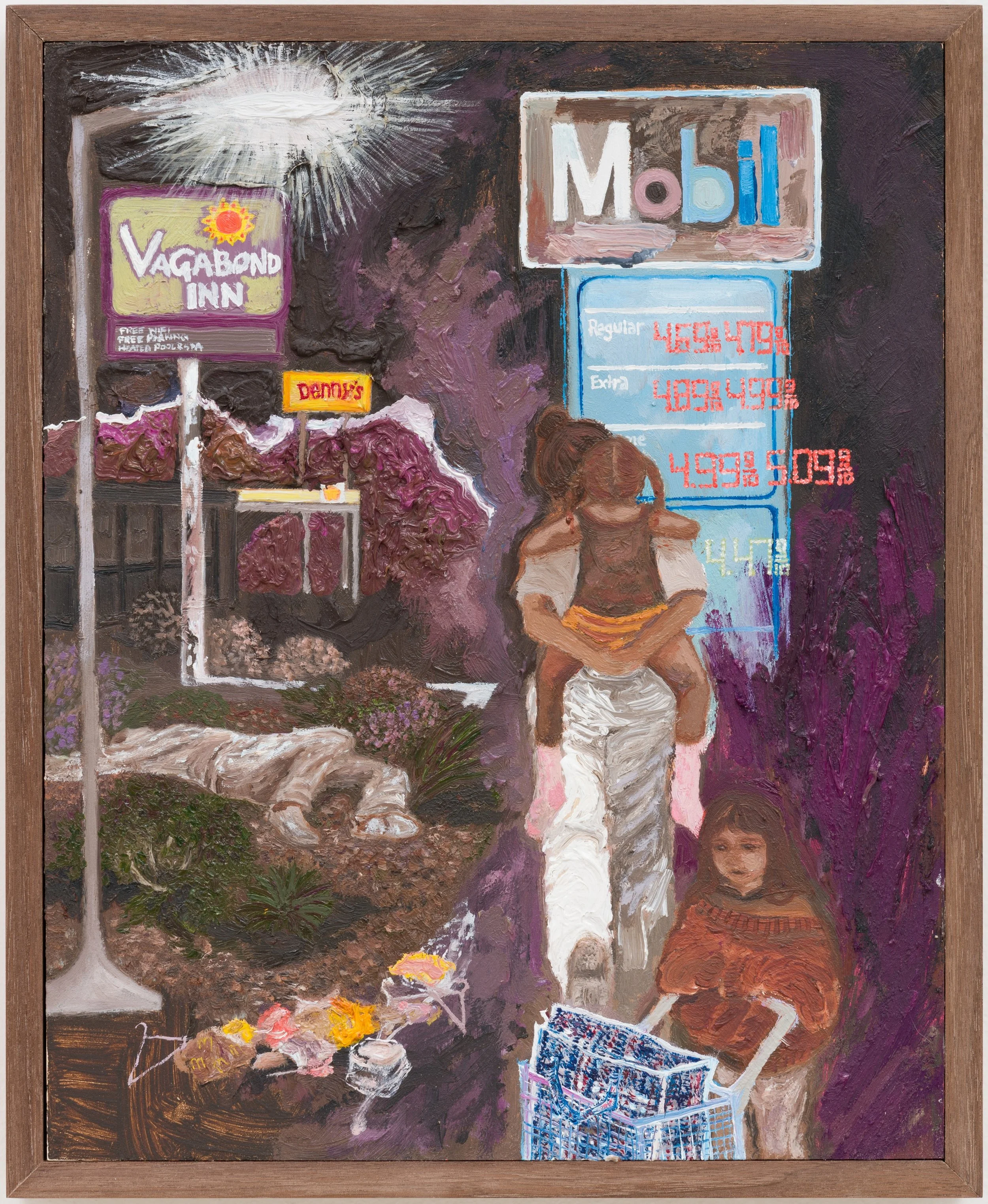
Highway Laundry, 2026. Oil on panel. Framed 10 3 ⁄4 " x 8 3 ⁄4 " x 2 1/4 inches. Courtesy of the artist.
Your paintings transform autobiographical memories into constructed scenes that hover between figuration and distortion. How do you negotiate the line between testimony and fiction when translating lived experience into image?
A lot of the works in Prey became imagined spaces stemming from combined photographs of different environments, people and points in time. There are also some pieces where I can recall my own place in a memory and I think about how I could rewitness that memory on a different plane where it could embody some of the sentiments or emotions I had at some point. For instance, in Kids Feel Alive (Mischief Night), I see myself quietly up late at night, in a small dark apartment in front of a computer with solitaire on the screen. On the other part of the panel there's almost this rally-like gathering of the free-spirited, where smoke emerges from trashcans, and pedestals of bricks prop up rebellious adolescents. Toilet paper engulfing the box I look out from. There's truth in feeling like I grew up paranoid and cautious, and felt anxieties and inadequacies in who I was and was to become even as a child. I think my upbringing introduced me to circumstances at an early age that shaped me to be this way, someone who had no room for mistakes, who knew there were consequences if I strayed too far or didn't handle my own actions responsibly. These thoughts helped bring me to the chaotic surreal energy that the painting embodies.
Through these works I’ve really tried to reimagine what the memories I'm drawing inspiration from could become, and a lot of the time the lived experience could be supported through a photograph of someone close to me that I break down and add different elements to like a different setting, objects in the room to recreate a new atmosphere, different facial expressions, etc. Those different elements whether it be baskets of laundry or christmas cards left on a table are inspired by my everyday life. As the painting develops so does the psychology of the space, which usually also determines a lot of the characteristics of the figures.
Living and working in Los Angeles, a city where conversations around housing and displacement are deeply present, does the surrounding environment influence how you think about home, memory, or instability within your work?
Living in Los Angeles has had a lot of influence. A lot of the motel paintings came to be in this body of work through my own upbringing, but also engaging with my community or different non-profit organizations. My family and I every year gather donations for families living in transitional housing, or for organizations prioritizing individuals living on Skid Row.
When we had moved to Los Angeles from Jersey, it was at the height of the pandemic, and seeing so many people on streets, sleeping in tents or wandering on the pavement without shoes was unsettling. Especially at the scale it was and still is. I’ve had some works in the past that have touched on circumstances my family had gone through, and still struggle with. One of my pieces, Eviction Motel, was a piece I made of my sister and I from memory where our family was evicted from our apartment on a winter night, finding ourselves in a motel room.
In Los Angeles my family and I had eventually moved into an apartment in Sylmar, adjacent to a highway with gas stations and a motel, settings that eventually became environments in some of the works within Prey. I would occasionally see lines of kids on my way to my studio, and didn’t realize until my neighbor informed my sister that a lot of families lived at the motel, and that those kids were waiting for transportation to their schools.
Fast forward a bit, when the time came that my family wanted to gather donations, my sister thought it could be a great opportunity to bring some stuff over. We had gone door to door asking if families would like anything. Now, when the door opens a lot of the time you could see stacked containers of belongings, a few people crowding up the space, as well as animals in their cages. There's this feeling of congestedness that emerges, and these spaces feel as though whatever life came before this transitional phase has been stuffed in between four walls. On the other hand, there's this feeling of tenderness as well. Kids sitting on their family members laps while they watch TV, teenagers playing and running up and down stairs, families gathering with pull out tables, food, and chairs to say a prayer over a community meal. It’s important to notice these details in these circumstances. They really do provide a sort of trust with the world, that everyday there's something good to look forward to.
Sometimes in the works there's this underlying theme, of children fending for themselves or in a position where they seem defenseless. Naturally I think I come back to feeling like in my own life I’ve had to grow up really quickly or maybe didnt feel i didnt have the support I needed. The adults, when they do make an appearance in the works, sometimes are helpless as well and are in a way “forgiven”. There's this realization of how complex the inability to show up in a lot of ways can be when they are living in survival mode. These inequalities a lot of the time are a result of a lack of resources and support, and I try to paint these imbalances through a lens that is open minded and compassionate.
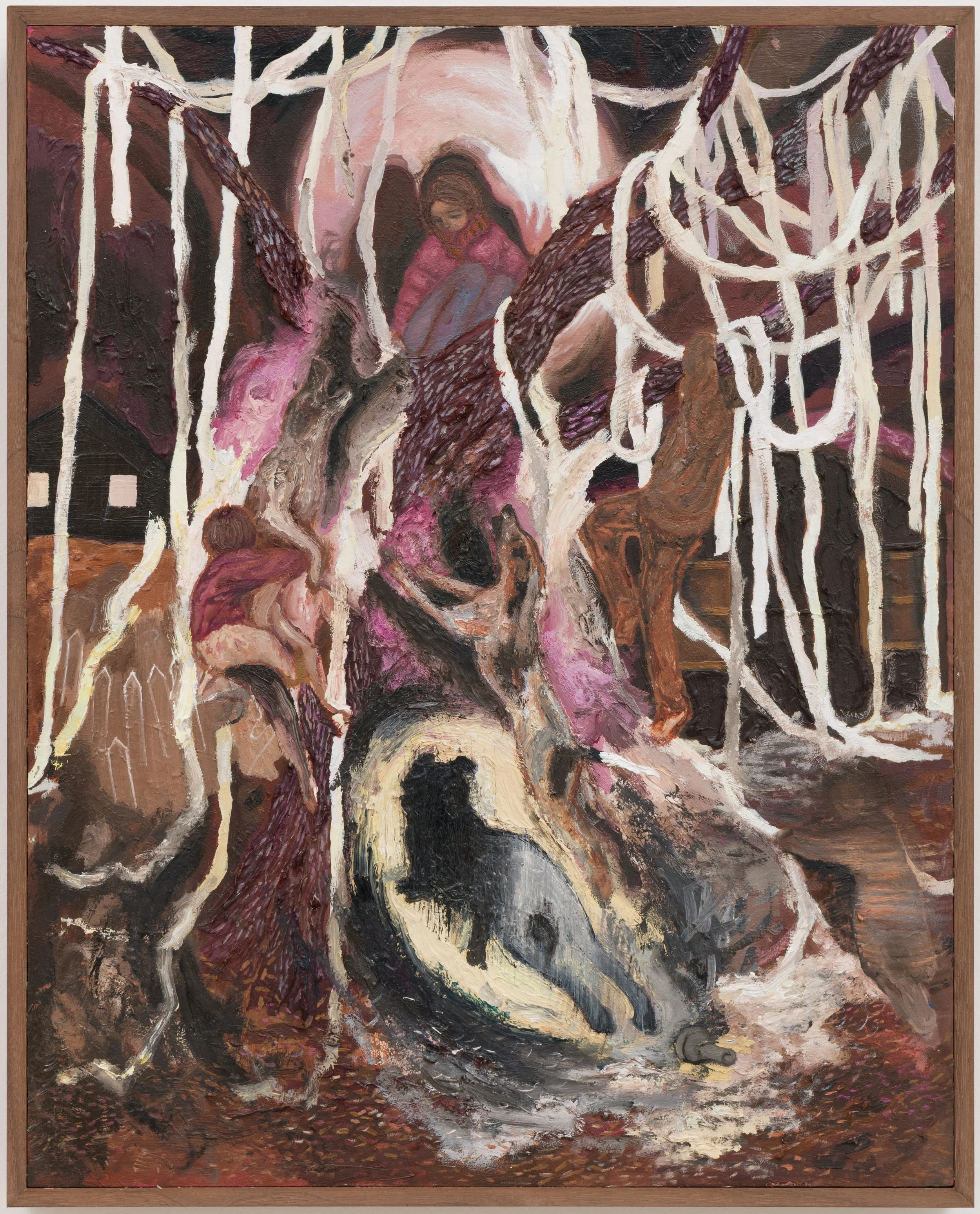
Chased Through the Night, 2026. Oil on panel. Framed 20 3⁄4 " x 16 3⁄4 " x 2 1⁄4 inches. Courtesy of the artist.
Domestic space as a site where power, vulnerability, and identity converge. In your work, how does the interior function politically as well as psychologically?
The interior space in a lot of the works is porous and impressionable, a place where circumstances are always subject to change or out of one's control. Throughout a lot of the pieces, there's varying interiors that are transient settings, such as the motel rooms, that are often overlooked as the kind of setting that an individual or their family would turn to. These spaces, although physically providing a roof over a family, majority of the time lack a significant amount of space, and a kitchen even to provide proper meals. There's also paintings which are inspired by smaller apartments, taking references of different places my family moved around to. In both cases, there's this element of individuals being on the move, sometimes throwing out things they can't find room to bring with them, picking and choosing what parts of them to leave behind.
In the motel room paintings, there are things packed into containers, boxes, and suitcases. A lot of how we choose to represent ourselves, in the food we share, the clothes we wear on our backs, and being able to express ourselves freely in circumstances as these could make someone feel powerless, and fragile, both physically and emotionally. These factors sometimes impact the future path of individuals, and stunt their potential and growth, as they may feel discouraged trying to “catch up” to others in society. On the other hand, there are these meaningful forms of resilience, where human beings find ways to adapt to their circumstances, whether they turn to their families, neighbors, or small significant forms of joy. There are paintings in which individuals or families create intimate meaningful worlds despite any obstacles they're met with.
In my painting Warmth in a Note there's two siblings in a small room enjoying karaoke. In Stranger Asks For Toilet Paper a young girl answers the door to a man who needs something from their home, meanwhile another young girl plays with paper towns on the floor. I love incorporating the “paper houses” into the works for this very reason. When I was younger, my sister and I made paper towns from brown paper bags. At the time this started, we had also been living in transitional housing, and despite not having much, we unknowingly found that strength in one another. These small objects find themselves in the work, and I've come to see them as a form of resilience. I think without realizing it we really gave one another support, just from creating from what we did have and feeding into one another's imagination. When our imagination is able to thrive and be nurtured, it helps foster visuals of our individuality and how we see the world with ourselves within it.
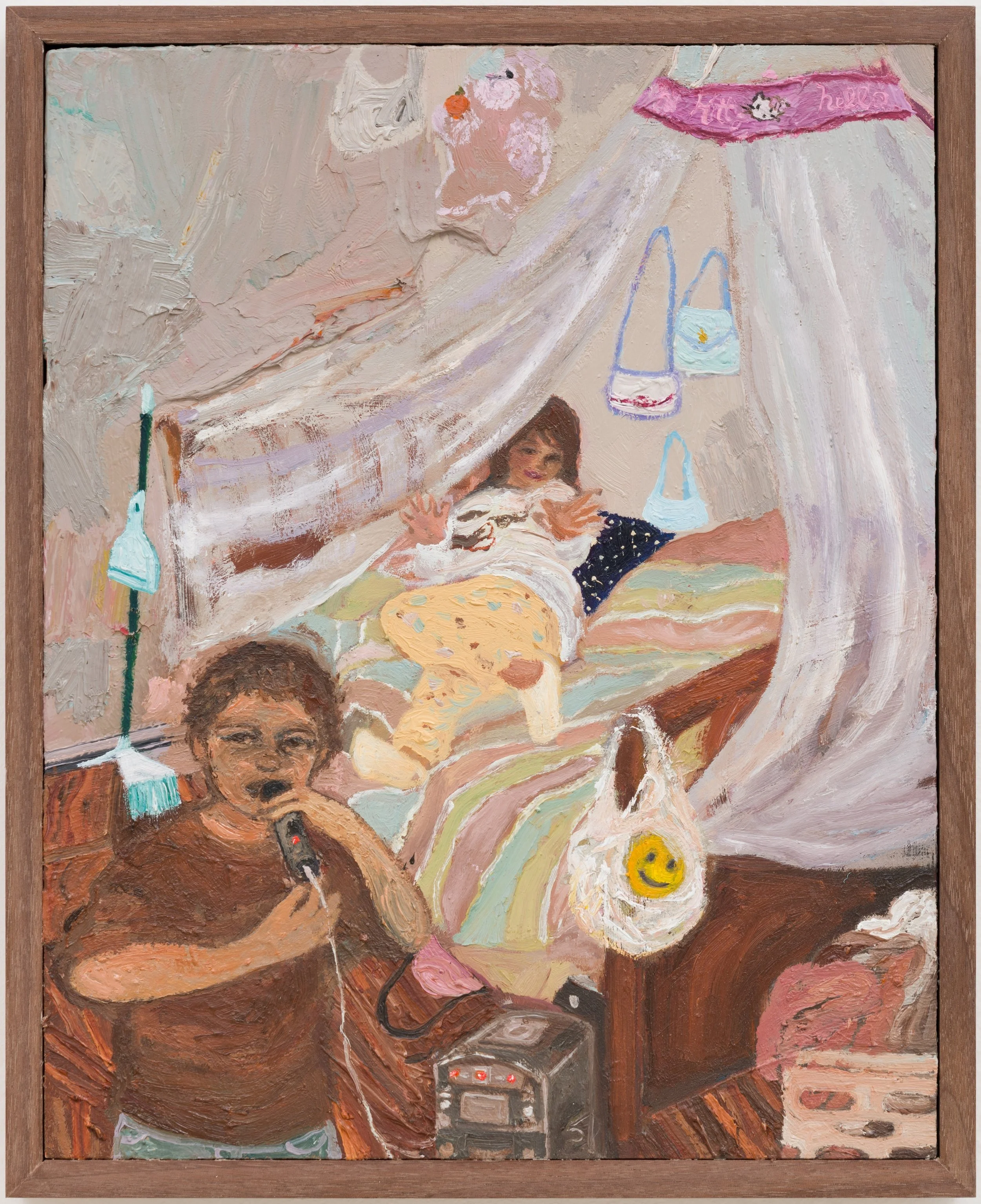
Warmth in a Note, 2026. Oil on panel. Framed 10 3⁄4 " x 8 3⁄4" x 2 1⁄4 inches. Courtesy of the artist.
Housing precarity is frequently discussed through statistics or policy language. What can painting articulate about houselessness that documentary or journalistic forms cannot?
I feel painting allows me to visually open up conversations and understanding from my own raw reality and recreate varying frames of mind. In the show there are a lot of ways in which the texture, movement, or disruption of space unveil the psychology of the figures or uncertainty of the environments they are presented in. Tender and soft energy can exist on the same plane as something unstable, threatening, and heartbreaking. I think about how some of the paintings have these imaginary elements to them, like maybe there's a portal children are being thrown into or dark waters filling up a room. These metaphorical spaces create a whole other framework of open-ended paths that on a deeper level pave the way to empathy and compassion.
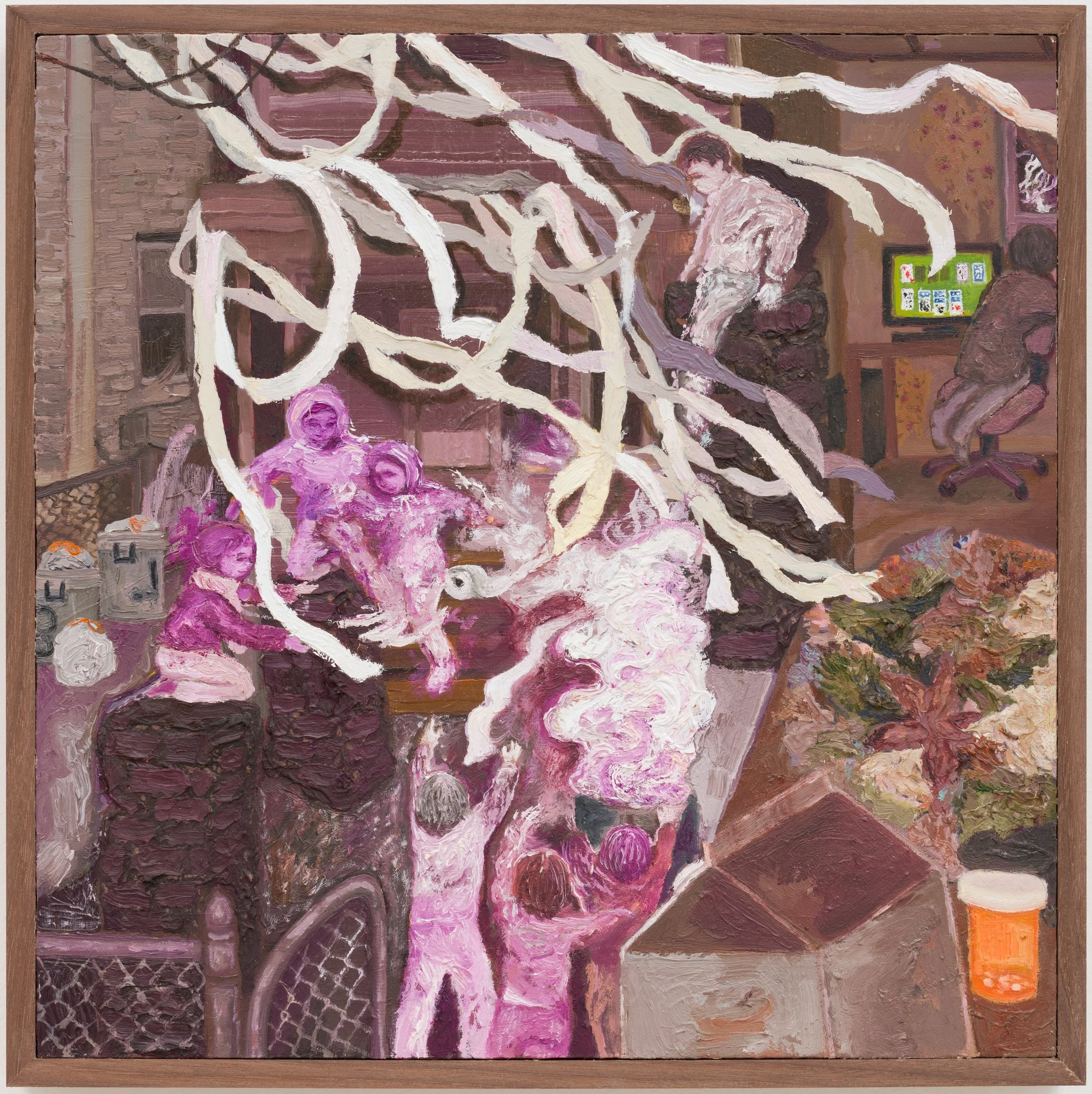
Kids Feel Alive (Mischief Night), 2026. Oil on panel. Framed 13 x 13 x 2 1⁄2 inches. Courtesy of the artist.
Your use of saturated color and spatial instability destabilizes otherwise recognizable scenes. Are these formal decisions intuitive, or do you see them as critical tools for questioning the reliability of memory?
When translating memory, there's always the thoughts of how you initially want to think about how you're going to make the movements, colors, settings, emotions, whatever it is come to life, but it's hard to know what it will become until you paint it and there's this cycle of trial and error. The use of color, texture, and space in my paintings are at times intuitive and ways that I express revisiting my own recollections.
There are moments where I use texture or color to break the space or disrupt it, because I want to recreate a feeling of memories being in flux or breaking down as one tries to recall them. Also how memories can be perceived in various ways over different points in time. A lot of the time where I choose to include certain colors or fragmented space can come naturally as I start developing the tone of the piece or I want to consider the inner world of the individuals. In Closer to Power, I had an initial sketch of kids playing wallball, and I didn't really imagine breaking up the space too much. But, I knew I wanted the painting to have this contrast with layers of white and dark browns.
Over time there was this underlying chaotic energy that came into play as I started including falling birds and balls, as well as crowding up the space with more bodies. Then afterwards came this sort of unleveling of the space, breaking off the court into rectangles, and larger fields of dark texture.
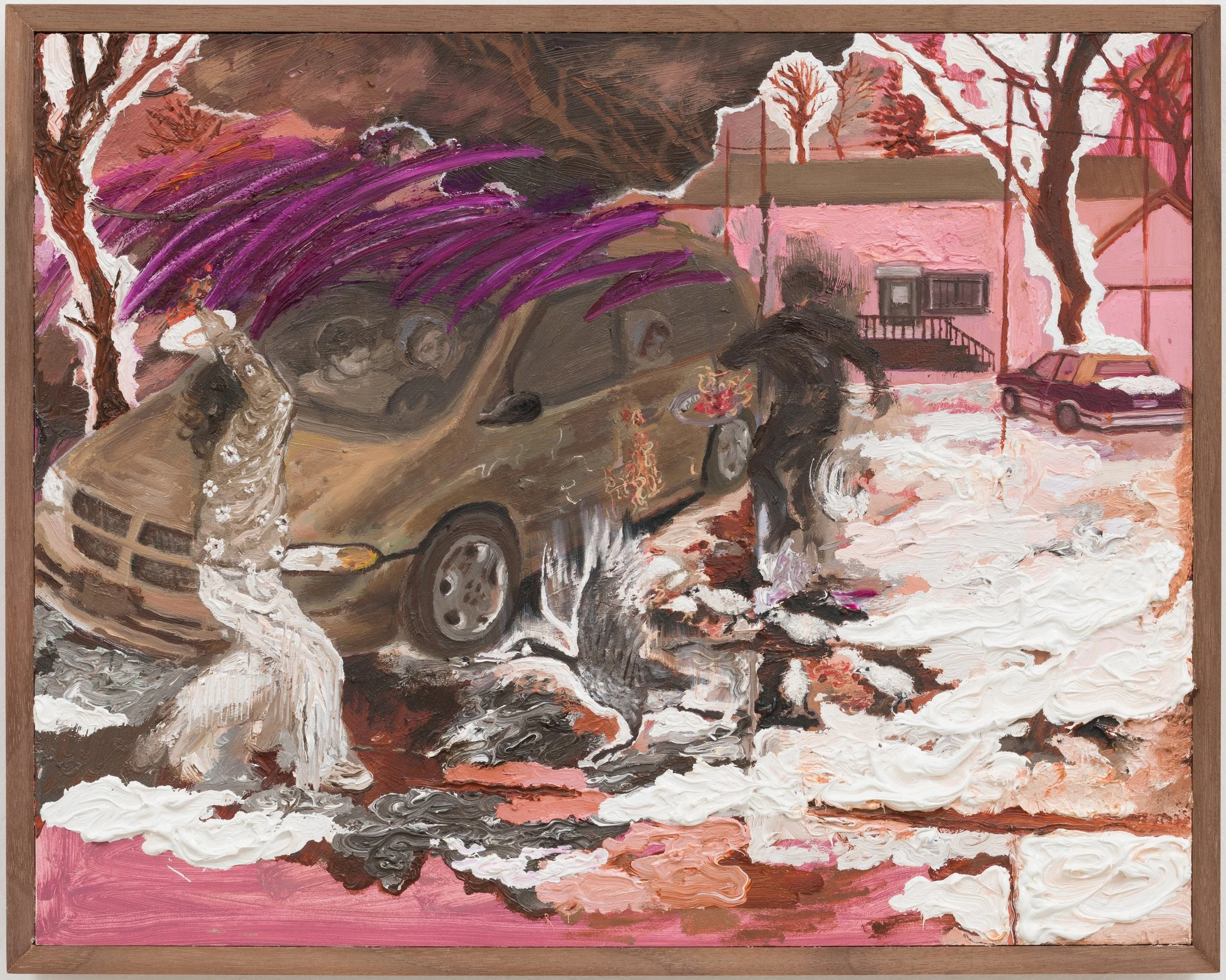
Spaghetti Car (Seeing Red in Winter), 2026. Oil on panel. Framed 11 3⁄4 x 14 3⁄4 x 2 1⁄2 inches. Courtesy of the artist.
There is a palpable tension in your work between tenderness and threat. How do you approach representing care within environments marked by instability, without collapsing into sentimentality?
Although there's a lot of emotion behind a lot of the pieces, focusing on the actual painting process itself I feel overpowers a lot of the more intense sentiments I'm shuffling through and incorporating as I go. A lot of the time, creating the painting involves figuring out how to mesh together all these different aspects of what I want the work to embody. I'm creating environments for these individuals to live in and focusing on where they are, what they’re doing, what they like or what their expressions are. It feels as though there's so many possibilities to connect with at once. And then there's these moments where you add all the aspects of color and texture and composition. When the piece is done I really feel a sense of calm. That feeling where you somehow took all these different aspects that may feel uncomfortable or uneasy and somehow managed to create a gentle frame for those who will see into it gives me a sense of growth.
The repetition on of beds, shared rooms, transitional interiors thread through your practice. Do you think of this recurrence as a form of archival return, a psychological revisiting, or perhaps a refusal to let certain spaces disappear?
There is a revisiting aspect in the works for sure and also in some cases just an obsession with painting beds (haha). Since I’ve started painting I’ve always made connections to interior spaces as shared spaces, especially just growing up in tight spaces and always sharing a bed or room with siblings or seeing my father take the couch in the living room as his bed. These spaces, although intimate, never really felt private. They encompassed a lot of feelings of unity and togetherness, and naturally also feelings of division and resentment. That push and pull finds itself in some of my works. Sometimes when the figures are portrayed by themselves, there's still those varying ranges of emotions there, and they linger within those spaces.
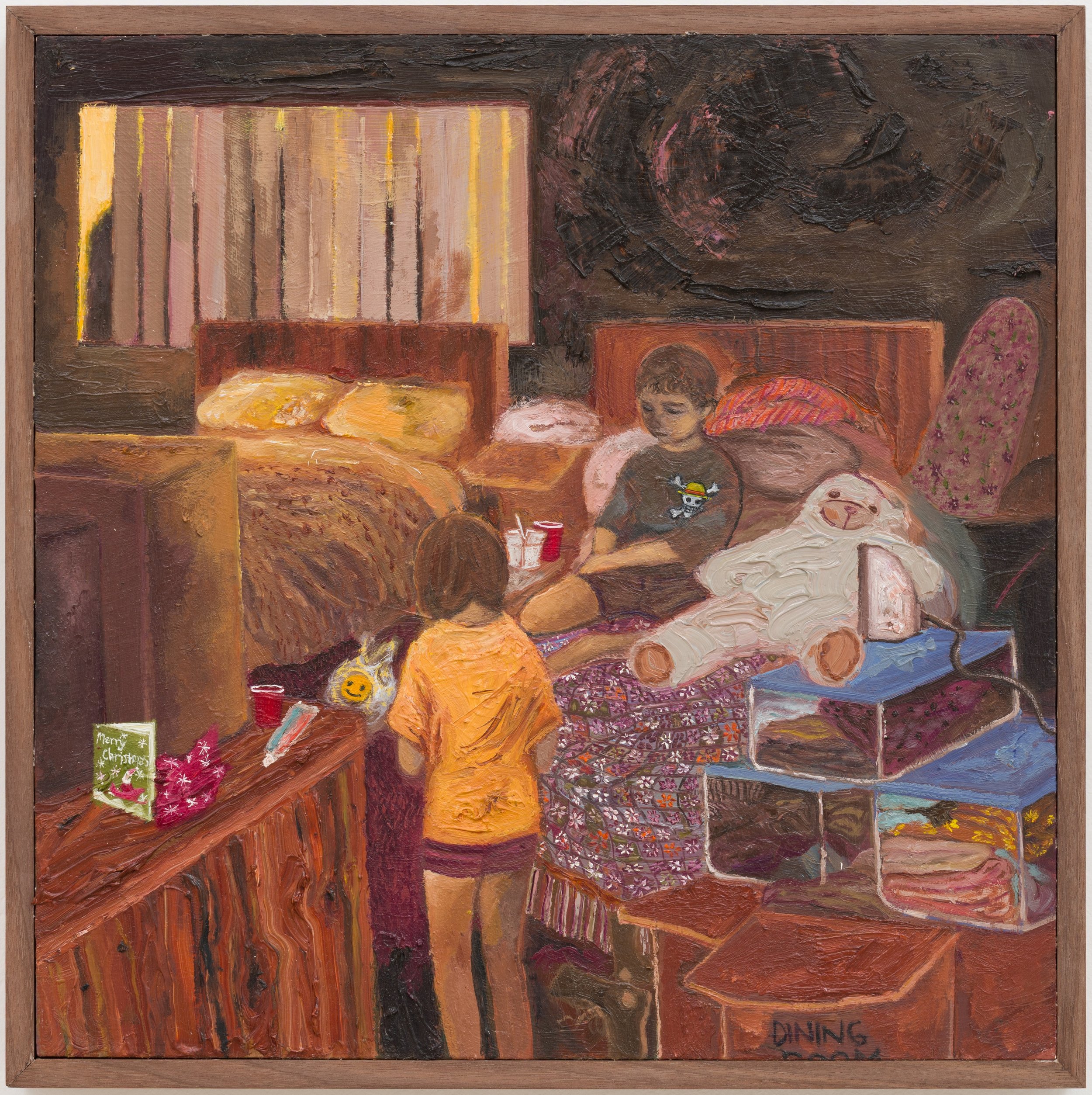
Heat in the Cracks, 2026. Oil on panel. Framed 12 3⁄4 " x 12 3⁄4 " x 2 1⁄4 inches. Courtesy of the artist.
To learn more about Veronica Fernandez visit her website.