Gowoon Lee talks to Phillip Edward Spradley
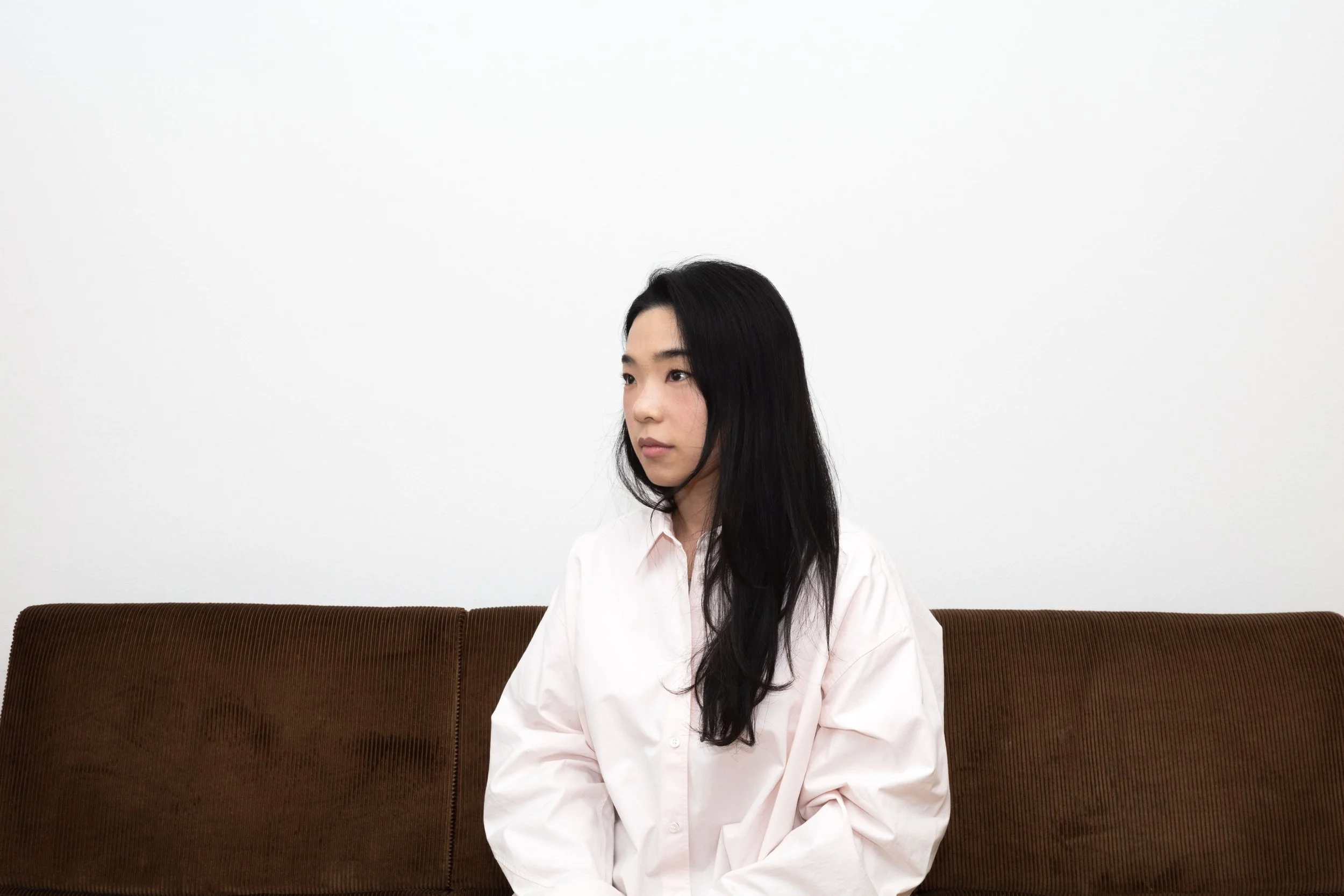
Portrait of Gowoon Lee, 2026. Photo by Tibor Bielicky. Courtesy of the artist.
Every generation carries with it a cast of animated figures that quietly shaped its emotional education. These characters entertained us during long afternoons and late nights, introduced us sometimes prematurely to themes of love, danger, and loss, and offered a temporary refuge from lived reality. For those who came of age in the 1990s, such figures often dramatized the extremes of experience: perilous falls, impossible rescues, and melodramatic devotion. Though time may have distanced us from these narratives, their emotional residue persists, embedded in memory and imagination.
Gowoon Lee’s painting practice operates within this lingering afterlife of animated imagery. By extracting familiar cartoon characters and objects from their narrative contexts, Lee positions them at the threshold between recognition and abstraction. These characters are detached from their original stories and become fluid. Across her work, these isolated forms can be read individually or collectively, assembling new, open ended narratives shaped by the viewer’s own recollections. Drawing on motifs that transcend cultural and generational boundaries, Lee constructs a shared emotional lexicon, transforming private nostalgia into a communal experience. Her work probes the intersection of memory, mass culture, and visual communication, asking how images endure and evolve amid constant cultural change.
In dialogue with a lineage of Western painters who foregrounded popular culture and mass media, Lee’s paintings subtly expose the latent violence, intoxication, and gendered archetypes embedded in children’s cartoons. These figures no longer belong solely to the screen. They circulate endlessly as mass produced commodities, available for nearly every occasion and stage of life. Their relentless repetition underscores both their cultural significance and their permanence. What initially appears as innocence or cuteness reveals itself as a carefully managed aesthetic shaped by media systems.
Lee’s paintings open a space of collective consciousness, a familiar terrain where these characters re enter our world at an expanded, bodily scale. While she can push recognizability to its limits, the associative pull of these figures remains intact. Soft, deliberate brushwork lends the images a sense of fragility, evoking the tenderness of memory and the emotional complexity attached to moments that may be violent, intimate, or deeply comforting. In this way, Lee’s work holds contradiction without resolution, allowing sentimentality and unease to coexist.
Lee earned her degree in Fine Arts from the Kunstakademie Düsseldorf. She has exhibited internationally, including presentations at Mai 36 Galerie, Zurich; JVDW, Düsseldorf; Braunsfelder, Cologne; and Meredith Rosen Gallery, New York. Her current exhibition, Here Kitty Kitty, is on view at Meredith Rosen Gallery, New York until February 21, 2026. Lee lives and works in Zurich, Germany.

Kitty Comb, 2026. Oil on canvas, 68 x 96 cm, Photo by Adam Reich. Courtesy of Meredith Rosen Gallery.
Phillip Edward Spradley: Did your attachment and interest in cartoon characters trace back to formative childhood interests, or were they figures you encountered later and gradually formed a relationship with?
Gowwon Lee: My attachment to cartoon characters does trace back to childhood. They formed an early visual and emotional landscape for me. What prompted me to work with them however, was not nostalgia alone but a shift that occurred when I returned to these images as an adult.

Kitty Sticker Sheet, 2026. Oil on jute, 80 x 60 cm. Photo by Adam Reich. Courtesy of Meredith Rosen Gallery.
Re-encountering these cartoons with emotional distance, I became aware of how differently they read and how layered and at times unsettling they could be. As a child, I accepted their worlds as exaggerated or fantastical. As an adult, I began to recognize how closely they mirror lived experience. In this sense, cartoons function almost like myths. They present absurd or hyperbolic situations while distilling fundamental human concerns such as desire, fear, power, and vulnerability into simplified and repeatable forms. This realization transformed these images from remnants of childhood into enduring cultural structures that continue to shape perception.
Cartoons also hold a particular significance for me because they often constitute our first second-hand experiences of the world. Before direct experience, they introduce us to ideas of danger, intimacy, loss, and desire in mediated form. Working with cartoons remains exciting to me because nothing compares to the intensity or shock of a first encounter. I remember a Hello Kitty backpack as the first piece of merchandise that made me want money of my own. It was the first object I associated with desire, and in that sense it marked an early awareness of value and attachment that continues to resonate in my work.
By isolating characters or objects from their narrative origins, your paintings exist in a space between abstraction and legibility. What philosophical ideas about perception, language, or meaning guide your decisions around how much an image can dissolve while still remaining recognizable?
I think of perception as inherently unstable and contingent, shaped through an ongoing negotiation between what is seen and what is remembered. Recognition is never purely visual; it is mediated by memory, language, and prior emotional experience. When I allow an image to dissolve, I am not attempting to obscure meaning but to investigate the minimum conditions under which recognition can still take place. That threshold interests me because it reveals how actively the viewer participates in producing meaning.
In this sense, my thinking aligns with Roland Barthes’ understanding of images as unstable signs rather than fixed carriers of meaning. Meaning does not reside fully within the image itself but emerges through the encounter between image and viewer. Language plays a parallel role here. Just as translation between languages is always partial and marked by loss, the visual translation from memory into image is necessarily incomplete. I am drawn to this incompleteness and the slippages it produces.
As an image becomes less tied to a specific character, it opens onto a shared but imprecise emotional field. What remains recognizable is not the figure in a literal sense but the affect attached to it. By suspending the image between abstraction and legibility, I aim to keep meaning open and contingent, allowing it to unfold through the viewer’s associations rather than resolving it within the painting itself.
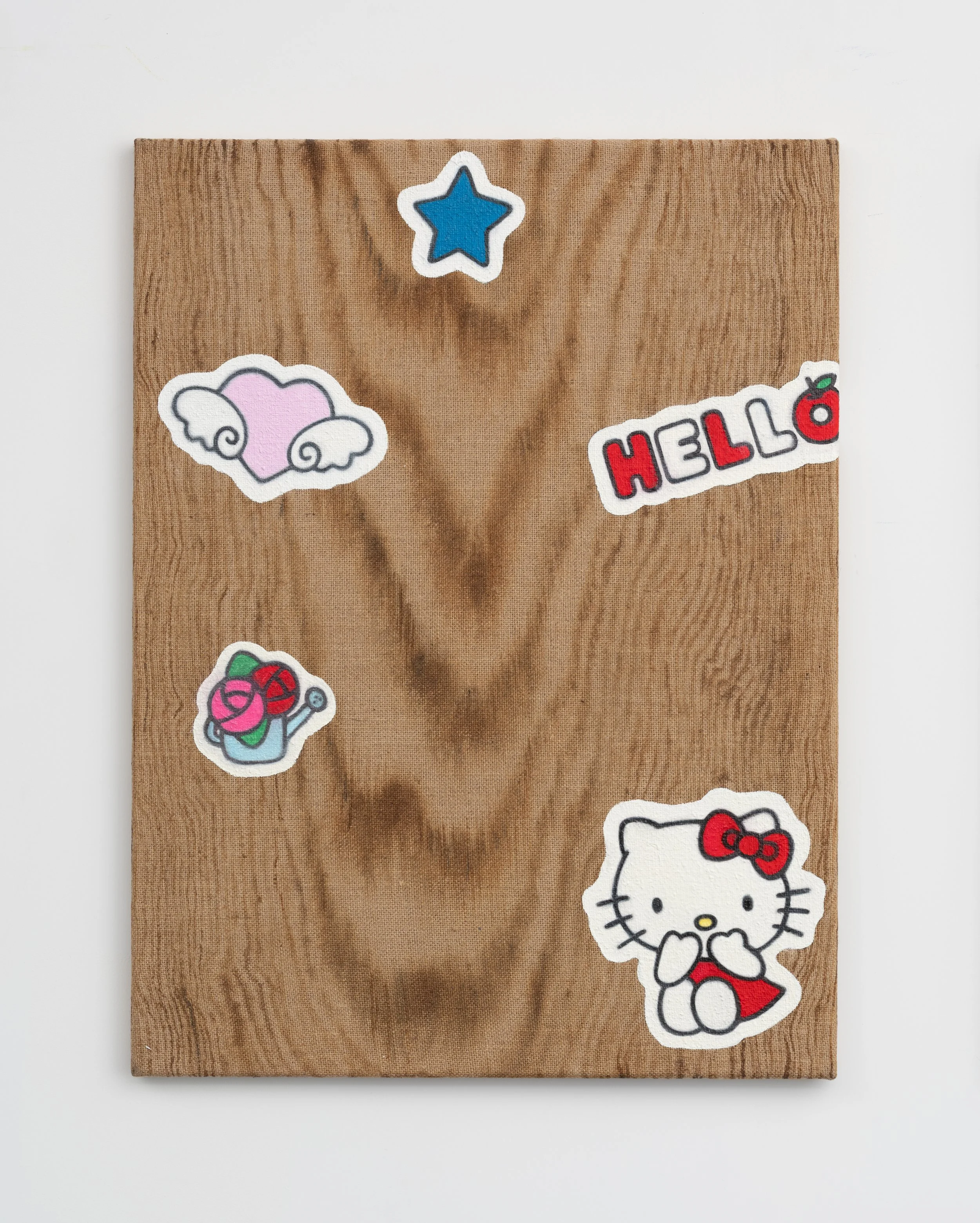
Kitty Sticker on Wood, 2026. Oil on jute, 80 x 60 cm. Photo by Adam Reich. Courtesy of Meredith Rosen Gallery.
Having navigated multiple cultural and linguistic environments, how has your experience shaped your understanding of cartoons as a nonverbal system of communication, and how does this inform your approach to visual storytelling?
Moving between cultures and languages made me acutely aware of how meaning can be conveyed beyond words. Cartoons were often the first images I could fully access before language, operating through gesture, rhythm, repetition, and exaggerated emotion rather than explanation.
As a Korean child, watching super popular cartoons from a completely different cultural context was intriguing, at times confusing and intimidating, and deeply informative. Nonverbal cues such as whistling to hail a cab or hugging and kissing to show affection, like Popeye sweeping Olive off her feet for a Hollywood kiss, were entirely foreign to my early understanding of social behavior. These cartoons functioned as a kind of nonverbal grammar, communicating affect and social codes that I learned to read before I could fully articulate them.
Hello Kitty entered my visual world from a different angle. Unlike narrative driven cartoons that required decoding gestures or actions, she did not ask to be understood in the same way. Her form is simple and static, defined by roundness, symmetry, and a deliberate absence of expression. This emptiness allowed space for projection rather than instruction. Instead of receiving information, I could attach feelings, desires, and meanings onto her surface. This distinction has strongly shaped my approach to visual storytelling. I am less interested in conveying fixed messages than in creating images that operate through affect and material presence, allowing viewers to project their own memories and associations into the work.

Kitty Under Centrifugal Force, 2026. Oil on canvas, 160 x 120 cm. Photo by Adam Reich. Courtesy of Meredith Rosen Gallery.
Nostalgia plays a central role in how viewers encounter your work, yet your paintings often reveal tensions beneath their softness. How do you negotiate this duality materially, allowing emotional attachment and critical distance to coexist on the same surface?
Nostalgia is often the entry point into the work, but I am cautious about relying on it. Nostalgia is frequently treated as a shortcut to winning people’s hearts, and I do not want the paintings to depend on that kind of immediate emotional access. For me, nostalgia is something to be tested rather than affirmed.
Materially, this tension is negotiated through the way I paint. I use soft, diluted layers and gentle brushwork that suggest tenderness and familiarity, but I interrupt that softness through distortion, erasure, and moments where forms remain unstable or unresolved. These disruptions prevent the image from settling into comfort.
Working in oil allows emotional attachment and critical distance to coexist on the same surface. The paintings may initially appear inviting, but closer looking reveals fragility, ambiguity, and resistance. In this way, nostalgia remains present, but it is slowed down and made uncertain, opening space for reflection rather than sentimentality.

Big Apple, 2026. Oil on canvas, 150 x 140 cm. Photo by Adam Reich. Courtesy of Meredith Rosen Gallery.
Iconic images have been described as stabilizing forces that quietly structure how we think and feel. Do you consider your paintings as inquiries into the philosophical power of images, and how might they propose alternative ways of seeing or remembering?
Iconic images stabilize feeling by becoming familiar, almost automatic, and in that sense they function as emotional structures rather than neutral representations.
By removing these images from narrative and commercial contexts and slowing them down through painting, I try to unsettle that stability. The images no longer deliver clear meanings or emotions. Instead, they become fragile and ambiguous.
This opens up alternative ways of seeing and remembering. Rather than reinforcing fixed nostalgia, the work reflects how memory actually functions: fragmented, unstable, and emotionally contradictory. Painting becomes a space where recognition is delayed, and meaning remains open rather than resolved.

Kitty Flipped Over, 2026. Oil on canvas, 170 x 130 cm. Photo by Adam Reich. Courtesy of Meredith Rosen Gallery.
Cartoon aesthetics and the notion of “cuteness” have evolved significantly across the history of mass media. How do you situate your work within this longer visual history, and what conceptual questions does this evolution raise for you?
Cartoon aesthetics and the notion of cuteness have evolved in close relation to mass media, but not all characters follow the same trajectory. Early twentieth century studios such as Disney and Fleischer relied on exaggerated motion, elastic bodies, and slapstick violence. In this context, cuteness functioned as a buffer that softened danger and made extreme physical or emotional situations accessible. These characters were inseparable from narrative, movement, and cinematic time.
Hello Kitty represents a fundamentally different model. She did not migrate from animation but was conceived from the outset as a figure designed to accompany everyday life. Introduced by Sanrio in 1974, Hello Kitty is largely static, minimally expressive, and detached from narrative. Her design emphasizes curvature, symmetry, and repetition, creating an open surface onto which emotions can be projected rather than performed. Cuteness here shifts away from storytelling and toward circulation, adaptability, and sustained emotional attachment across objects and life stages.
I situate my work within this distinction. After working with American cartoon figures that emerged from animated narratives, I became interested in Hello Kitty precisely because she operates through a different logic. In Here Kitty Kitty, she functions not simply as an icon but as a structural model for how images inhabit daily life without relying on story or motion. When translated into oil painting, these figures are removed from their everyday utility and commercial function. Painting slows them down and exposes the visual and affective systems that allow such images to persist.
Conceptually, this evolution raises questions about cuteness as a form of emotional conditioning. What kinds of values, gendered expectations, or forms of discipline are embedded in images designed to be endlessly present and adaptable? How does repetition across everyday objects naturalize certain emotional responses? By pushing these images toward abstraction, my work examines cuteness as a shared emotional archive that continues to shape perception and attachment long after childhood.

Gowoon Lee, Kitty Problem 1, 2026. Oil on jute, 119 x 119 cm. Photo by Adam Reich. Courtesy of Meredith Rosen Gallery.
Your works invite viewers to project their own memories and associations onto the images. How intentional is this openness, and how does it relate to your thoughts on authorship, interpretation, and the shared nature of visual culture?
The openness in my work is very intentional. I don’t think of images as sealed containers of meaning, but as things that are carried, altered, and reactivated as they move between people, contexts, and time. In that sense, I often return to the original meaning of translate: not just linguistic conversion, but the act of carrying something across from one place to another.
I see visual culture operating in a similar way. In a world overflowing with images, meaning is never fixed or produced by a single author. Even iconic figures like Hello Kitty carry layers of associations that shift depending on who encounters them and in what context. Images circulate, overlap, and respond to one another, constantly translated through memory, experience, and cultural frameworks. When viewers project their own associations onto my paintings, it is not a loss of authorship, but a continuation of this process.
For me, authorship lies in setting the conditions for that movement rather than prescribing interpretation. By leaving images open, partially dissolved, or detached from their original narratives, I create a shared space where meaning flows between the work, the viewer, and a broader collective archive. In this way, the work reflects how images function in contemporary culture—not as isolated statements, but as active participants in an ongoing exchange shaped as much by reception as by intention.

Gowoon Lee, Kitty Row, 2026. Oil on canvas 70 x 160 cm. Photo by Adam Reich. Courtesy of Meredith Rosen Gallery.
What are you looking forward to right now? Are there any trips, projects, themes, or directions you are excited to explore?
I recently moved to Zurich, which feels less like a simple relocation and more like the beginning of a new phase in my work. This shift coincides with my return to the cartoon series, now approached with a more focused attention to how text operates within the visual language of cartoons, from signs and letters to episode titles and thought bubbles.
What draws me to this aspect is the way simple text can accelerate narrative understanding and produce an immediate form of communication within a storyline. In cartoons, and similarly in early cinema before synchronized sound, text does not merely supplement images; it actively shapes perception, directs attention, and stabilizes meaning. In this sense, written elements function as structural devices that organize the rhythm and legibility of visual worlds.
I’m drawn to the irony of exploring text now, since I was initially attracted to cartoons for their magical ability to transcend language barriers. I’m curious to see what kinds of tensions emerge when text is juxtaposed with a simple, isolated image, and how meaning shifts, intensifies, or even contradicts itself in that encounter.
Zurich feels particularly relevant for this line of inquiry given its historical relationship to design and typography. More broadly, my practice tends to unfold in cycles, returning to different series over time rather than progressing in a strictly linear way. This cyclical approach allows distance to accumulate, preventing stagnation while creating space for each body of work to be re-entered, re-read, and conceptually deepened
To learn more about Gowoon Lee, follow her on Instagram.