Ophelia Arc talks to Phillip Edward Spradley
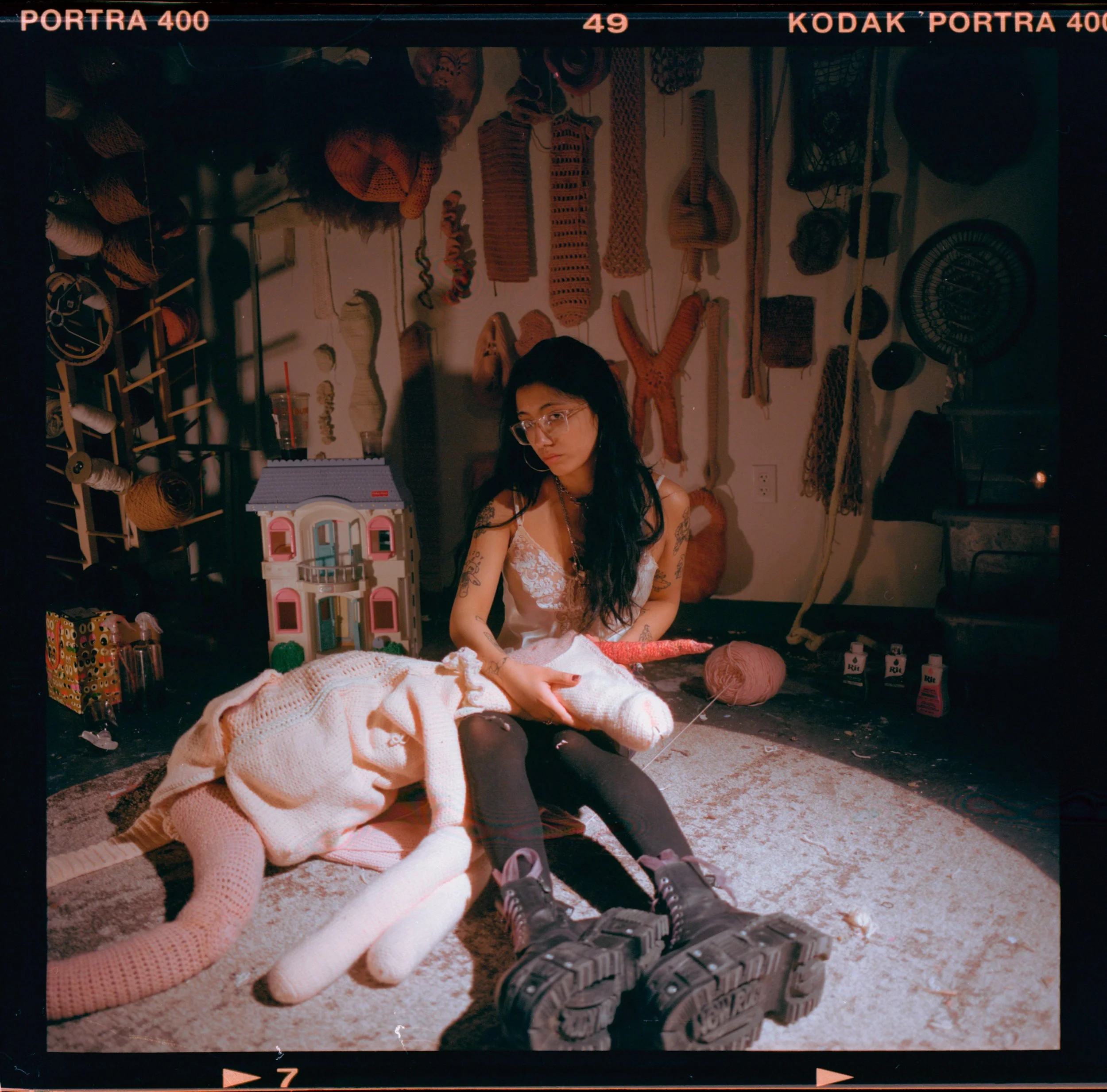
Portrait of Ophelia Arc, 2026. Courtesy of the artist. Photo by Elias Fong.
At twelve, Ophelia Arc picked up a hook and a length of yarn and never quite put either down again. Years later, she still moves through the world with a skein tucked into her bag, ready at any idle moment. In Arc’s hands, yarn stretches, splits, knots, and reforms, less a material than a companion in an ongoing negotiation between memory and survival. If time itself could be crocheted, she would have tried by now.
Working primarily in sculpture through crochet, Arc treats material as a carrier of emotional residue, a surface where softness and violence are not opposites but cohabitants. Her work unfolds through sustained, often obsessive acts of making that span crochet, hand-sewing, drawing, and assemblage. Across these processes, she traces how lived experience settles into the body and how repetition can operate simultaneously as care, control, and a quiet insistence on being here at all.
Her sculptures confront participants with forms that feel unmistakably bodily yet resist stable identification. Crocheted membranes sag and stretch, stitched apertures open and close, and biomorphic structures hover in states of suspension that oscillate between intimacy and unease. Using yarn, tulle, gauze, and found materials, Arc constructs environments in which tenderness cannot be disentangled from injury. Surfaces recall skin pushed past comfort, marked by gestures that read as both protective and harmful. What might initially register as lesion or wound gradually shifts into something more complex, less spectacle than record, as if the work is keeping track of something the body refuses to forget.
This material language is grounded in a research-driven approach informed by psychoanalytic thought, feminist philosophy, and autobiographical reflection. Arc repeatedly circles emotional contradictions such as care and violence, nourishment and deprivation, melancholia and mania. Rather than resolving these tensions, she embeds them into the work itself, allowing each stitch and seam to hold competing states at once. The result is not a synthesis but a suspension, a space where oppositions remain productively unresolved.
Crochet, in this context, carries particular weight. Long associated with domestic labor, repetition, and forms of care that often go unrecognized, the medium becomes in Arc’s practice both method and subject. Her approach reframes crochet as a bodily and cognitive process, one that accumulates meaning through duration and insistence. The act of making functions as both regulation and record: a way of grounding the self while also leaving behind evidence of its passage. Arc has noted that she crochets constantly, in transit, in conversation, even without looking. Over time, this ceaseless engagement collapses the distance between process and person, making it difficult to say where the work ends and the act of sustaining oneself begins.
In parallel with the intensity of her making, Arc maintains an unusual openness about the conditions that shape her work, including labor, mental wellness, and obsession. This transparency resists the myth of artistic remove, positioning her work not as a rarefied object but as part of an ongoing, lived negotiation. That stance aligns with the emotional directness of her sculptures, which invite participants into a space that is at once specific and broadly legible.
Arc received her BFA from Hunter College and her MFA from Rhode Island School of Design. Now based in Queens, New York, she has exhibited internationally at galleries and institutions including 81 Leonard, Kates-Ferri Projects, Lubov Gallery, and Lyles & King in New York; Abigail Ogilvy Gallery in Los Angeles; and Tube Culture Booth in Milan.
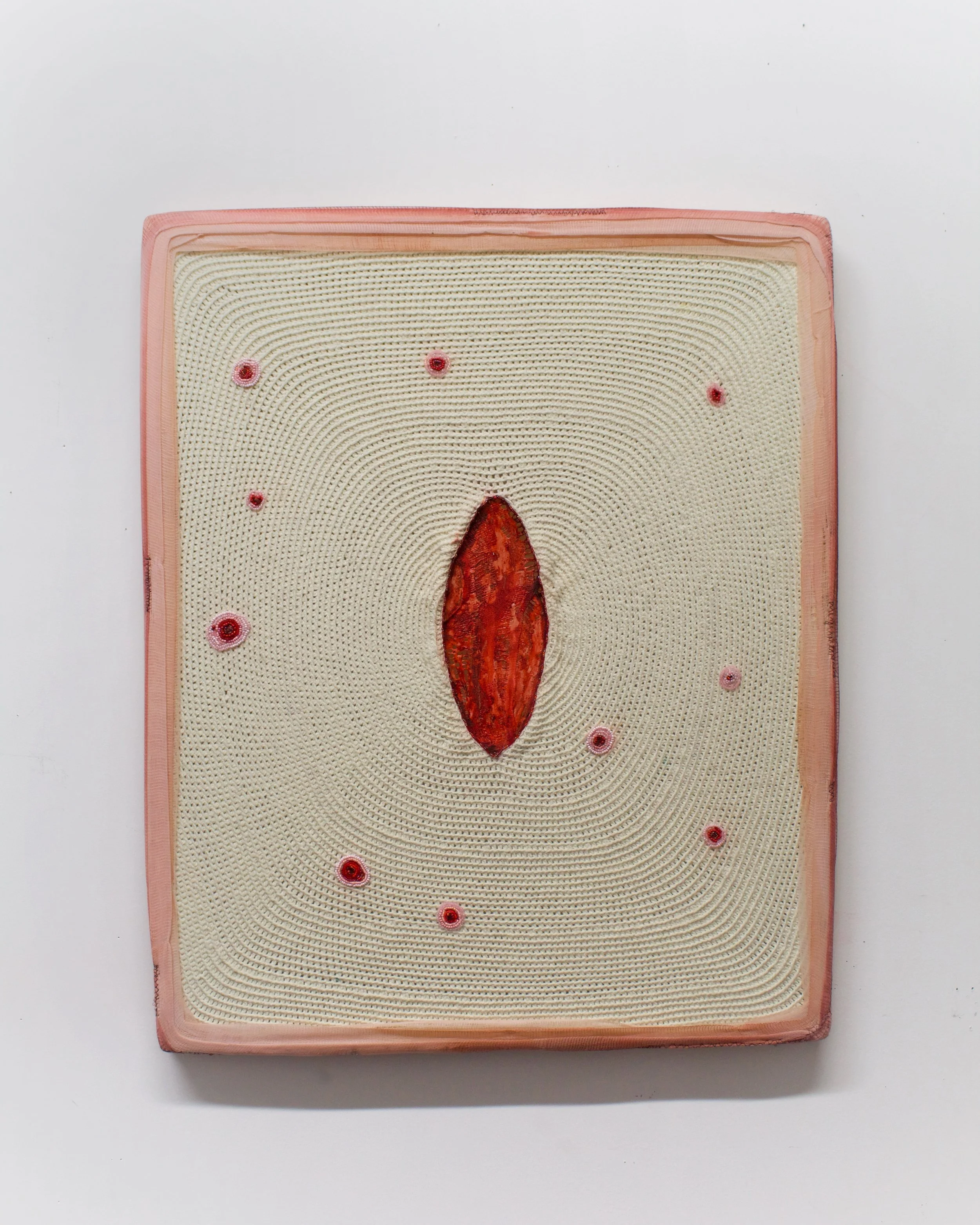
self-mutilate / mend, 2026. Yarn, gauze, dye, beads, artists hair and latex on found stretcher. 31 x 2.5 x 38 inches. Courtesy of the artist.
Phillip Edward Spradley: Your work seems deeply tethered to repetition, not simply as a formal strategy, but as a condition of living. You’ve spoken about constantly crocheting, I’m curious how you understand repetition psychologically. Does it function for you as ritual, compulsion, self-preservation, or some shifting combination of all three?
Ophelia Arc: I've actually been wondering about the difference between ritual and compulsion, like where the line separating the two lies. My understanding is that rituals are something that reads as beneficial, voluntary in nature and overall societally accepted. Compulsions on the other hand function as an incessant need, and can be seen as odd or against logic.
Self preservation can exist on a spectrum, if someone attends church or exercises to maintain a mental well being, that can be seen as a self preservation tactic. As soon as that tactic is pushed to a deemed unhealthy extreme it begins to go from ritual & habit to compulsive & obsessive. At that point it begins having the opposite effect, like a nightly prayer turning into hours upon hours consumed by praying, or daily exercise becoming obsessive to the point of harm. Crochet for me absolutely became a sort of habit, its repetitive and mind numbing properties ended up becoming a more palatable way to cope with what I always saw as nervous energy. This “energy” would result in these physical tics or stims.
As a kid I had this hand shaking like tremor, incessant leg shaking, and these jerk-like head movements that I did in pairs of 3 or 5. Crochet and its ability to become behavior was able to subdue a lot of those quirks. That being said, as time has gone on I've definitely seen crochet begin to consume a lot of me, it has become compulsive, especially when I'm in some state of duress. Luckily it reads as more constructive and productive than hitting myself against something so people kinda cheer it on. In short yeah all three for sure, if the habit is self preservation it exists on a line graph with ritual on one end and compulsion on the other. I slide from end to end based on other extenuating circumstances.
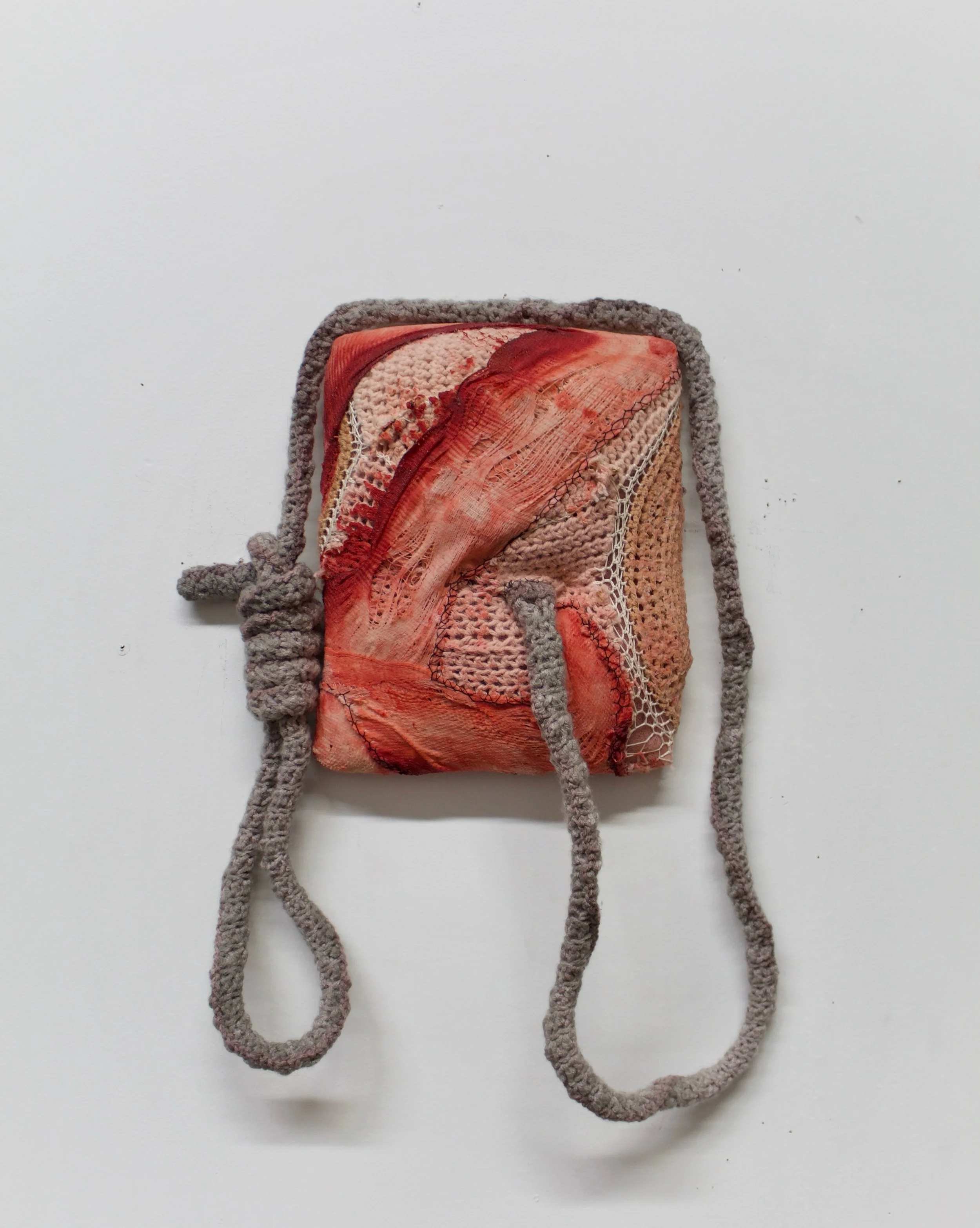
umbilical phant(om)asy I, 2026. Hand dyed yarn, latex, tulle, thread and dye one wood panel. 8.5 x 10.x 25 (dimensions variable). Courtesy of the artist.
The forms in your work feel intensely corporeal, yet they resist fixed identification. At different moments they evoke skin, organs, wounds, membranes, or protective structures, but never settle entirely into representation. What interests you about keeping the body suspended between recognition and abstraction?
There is something about ‘affect’ completing, or rather aiding the work that I really enjoy. I've had moments where I make a piece and in the conception I believe I know how I'm going to read it but something else changes my perception. Usually birthdays of family members lining up or even a physical ailment like the time I gashed my knee with staple gun staples. Its ambiguousness gets pushed in a different direction as a result of its response to the context. I think this also allows for a piece to be entered into from different vantage points; understood on multiple levels. I don’t believe any good work can be universally loved or even liked but I do think a successful piece is one that evokes a response which calls to a viewer in some way.
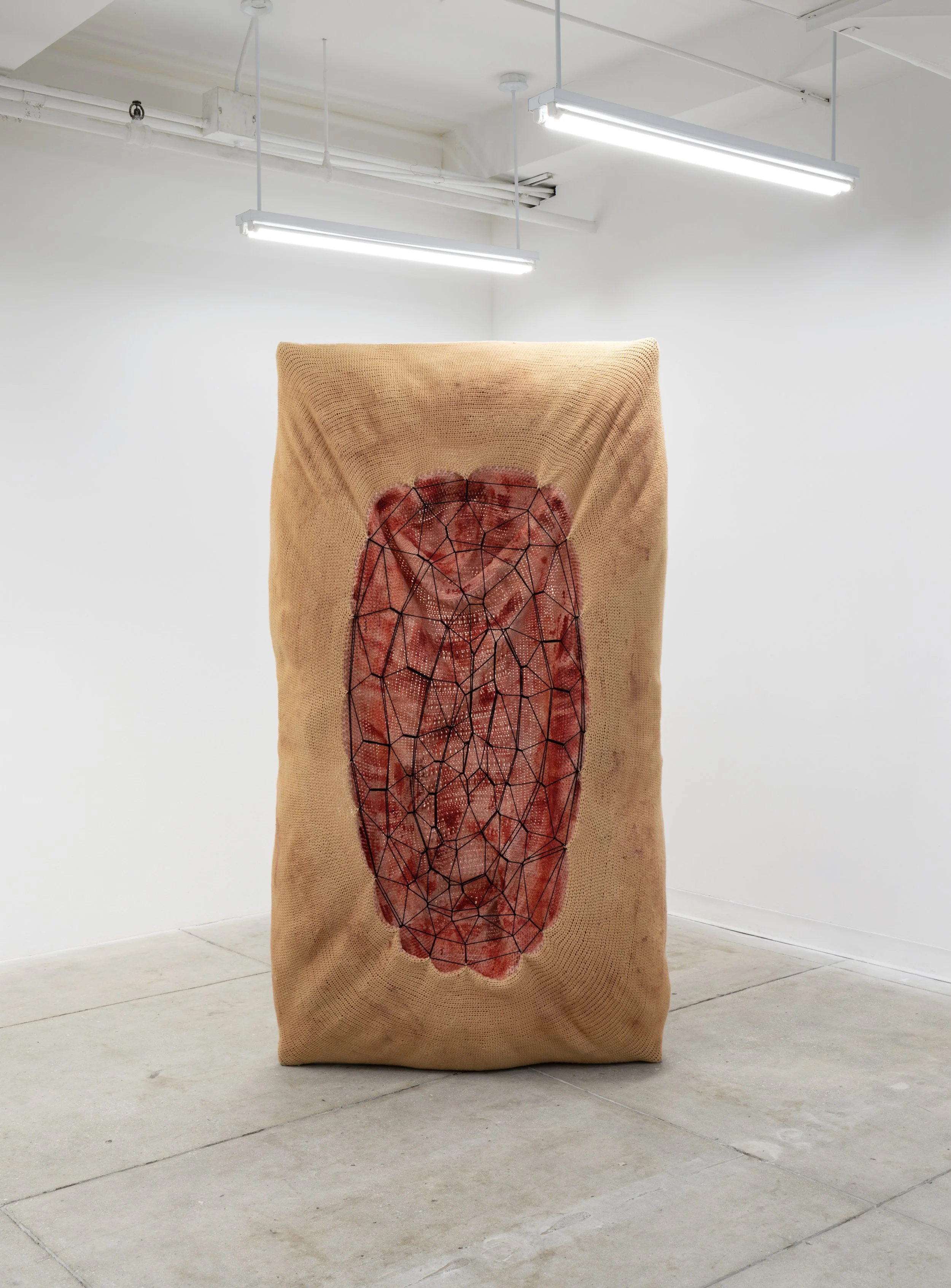
Wo(und) mb, 2026. Hand dyed yarn, latex, dye and varnish on twin bed frame. 18" × 42" × 78 inches. Courtesy of the artist. Photo by Adam Reich.
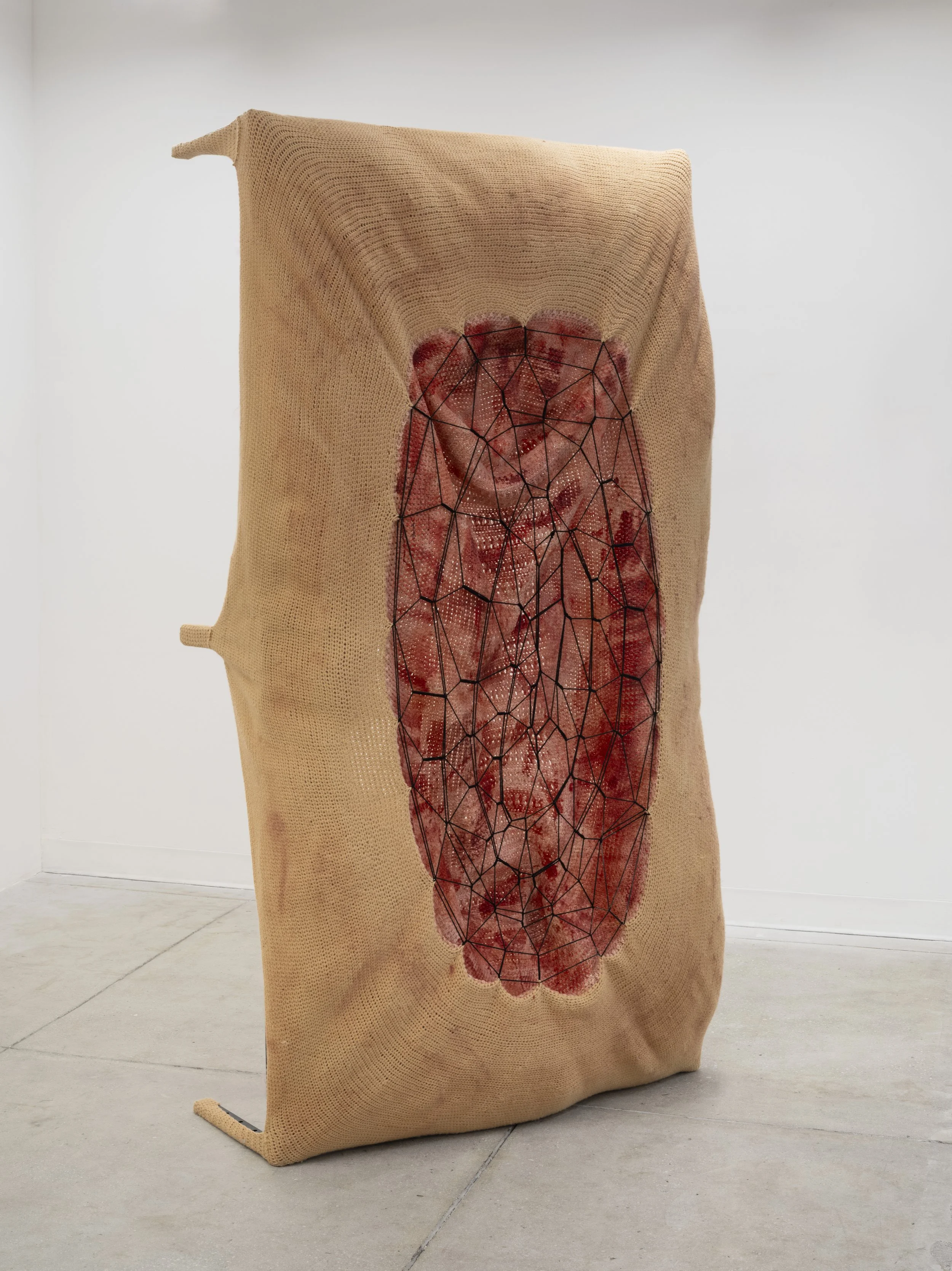
Wo(und) mb, 2026. Hand dyed yarn, latex, dye and varnish on twin bed frame. 18" × 42" × 78 inches. Courtesy of the artist. Photo by Adam Reich.
Textile carries such loaded cultural associations with care, domesticity, femininity, and labor, yet your work destabilizes those expectations almost immediately. How do you think about using softness as a material language for confronting psychological discomfort, vulnerability, and bodily rupture?
Touch is our first language. It's the first sensory experience we share with another after being birthed. We feel the touch and softness of someone and then of something. Textile in this way becomes universal. D.W Winnicott who I probably reference too often, has this theory of the the transitional object, and how it is the first “not me” possession that allows a child to understand its autonomy and in turn transition from being dependent to indapendent of the mother. I feel the yarn has become this proto object that has allowed me to transition from this adolescent self destructive state to something (debatably) more sustainable, palatable. In conjunction, the work is incredibly out of physical reach to everyone else. It isnt not meant to be handled the way I get to handle it.
My experience with what I create is one derived of the hand to material connection. It is made in both the language of what im articulating as well as my own understood language of touch. I feel this amplifies that psychological discomfort. Many people want to touch or even grab my works. I’ve had experiences where children in gallery or art fair settings would instinctively reach out to touch or even hug the piece. Adults too if im being honest. This adds to that limbo, or bodily rupture. Wanting to touch something, being unable to and then questioning if you actually would still want to touch it if you where given the chance. When I had open studios, I told visitors they could touch the pieces hanging and on the wall, to my surprise very few actually wanted to, or if anything they alluded to being enticed but ultimately chose not to. The work (I hope) enacts a feeling on this fineline between intruige and revulsion.
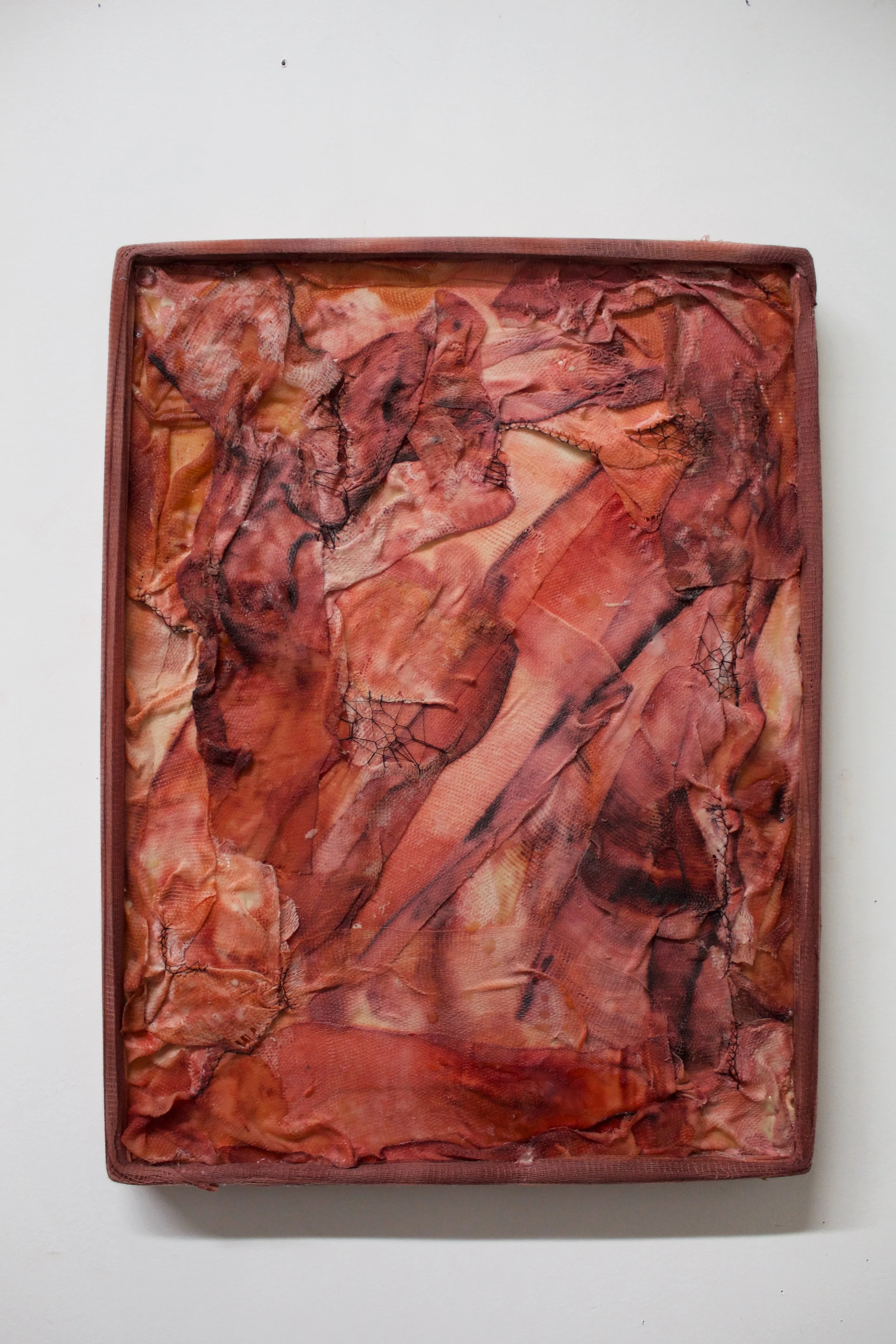
gauze skin I, 2026. Latex, hand dyed gauze and thread on found frame. 16.5 x 1.5 x 22 inches. Courtesy of the artist.
Across your sculptures, surfaces appear marked by accumulation: scars, sutures, stains, abrasions, traces of injury and repair. I wonder if you see the body primarily as a site that stores memory, or if memory itself becomes something mutable through embodiment and repetition?
I feel like a lot of my work is me trying to escape my body or outrun it. Of course, my body remembers these repetitive motions like hand sewing and crocheting but there is also a threshold reached when the repetition becomes numbing and I essentially attempt some sort of failed cartesian split between the concepts I’m working with and the body physically enacting what it takes to make them. When doing something that is so laborious and melodic you kind of lose sense of place and time but I’m shocked back into it when I feel the clicking of my wrist or a knot forming in my back. So it’s not so much mutable as it is numbing or attempting to numb.
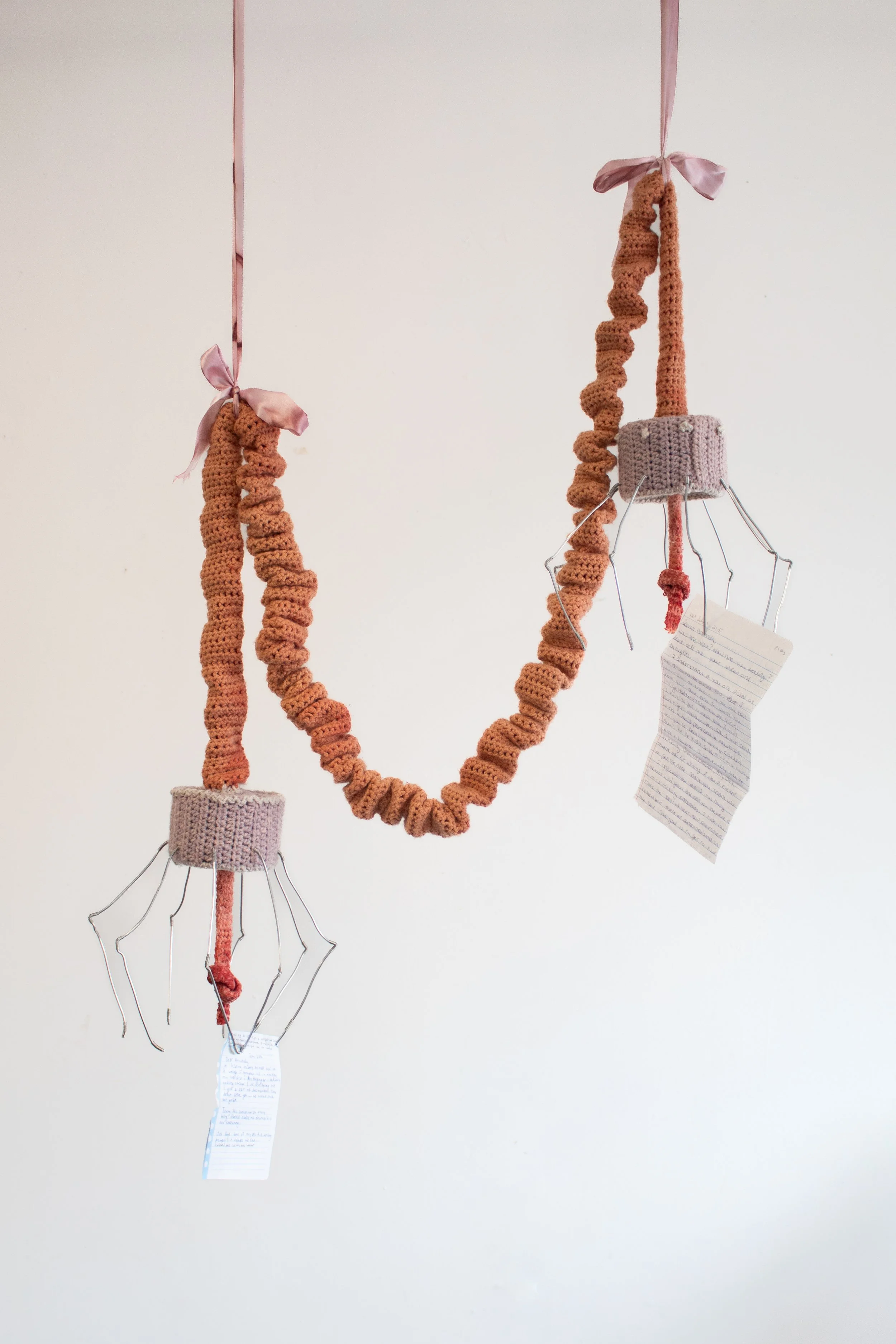
dual ended gripping mechanism (i am just like you but worse), 2026. Hand dyed yarn, industrial paper tube, wire, latex, replicated diary entry (6/28/15, 6/30/15), pages 2& 3 of replicated note from the artists mother (7/1/15) and elastic. 12 x 80 inches (variable). Courtesy of the artist.
Psychoanalytic theory and feminist philosophy clearly inform the conceptual architecture of your work, but the sculptures never feel subordinate to language or illustration. How do theoretical frameworks enter your process materially? Do ideas begin intellectually for you, or do they emerge through the physical act of making itself?
My works all stem from a set plan, having this plan allows me to veer off into different paths and trails of the process. If you dont know where you’re going you’ll never get anywhere, having a plan although may sound stifling actually gives me the confidence to follow the intuition i’ve strengthened throughout the years. It allows me to experiment, to keep things from feeling stale or overdone. All that to say, it’s these texts I read while crocheting, the connections I form from them, that inspire initial sketches. This allows me to envision the different properties and approaches i want to take for the piece. the ideas grow out from there, a grounding text helps me from straying too far away from my central thesis.
I follow the rabbit down the hole to finish or continue something within a given body of work. its a way of using the “soft” logic of craft work like crochet, and the “hard logic” of intellectual understanding. I feel they both feed each other, make one another stronger. Art lets me learn from everything, to further understand something specific. It’s probably why I never saw myself going into something as stifling as an independent area of study like philosophy or psychology.
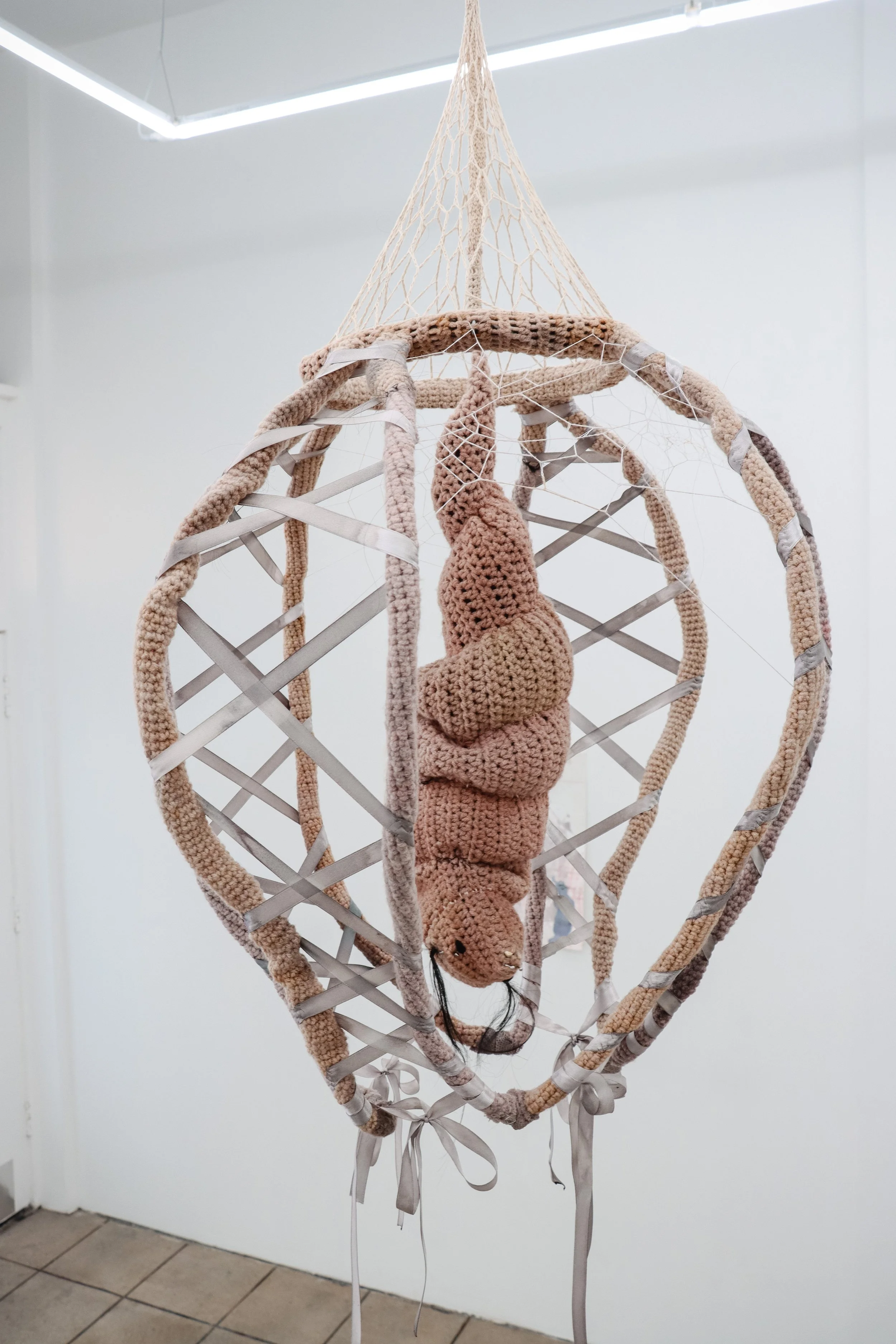
hypercathexis (pupa), 2025. Hand dyed yarn, wire, welded hoop, hand dyed ribbon artists hair, thread, magnets, septum ring, swivel hook, white jadon max dr martens and baby teeth (1940's). 18 x 18x 55 inches (variable). Courtesy of the artist.
There’s a persistent tension in your work between care and violence, tenderness and violation. Even gestures of repair, stitching, binding, mending, can feel simultaneously protective and invasive. Are those contradictions something you consciously construct within the work, or do they reveal themselves organically through the process?
I love to work with paradox, that in between space of comforting and discomforting. I’ve been doing a lot of thinking and writing on the idea of caring for something and still managing to harm it in the process. Intentions cease to be enough. I think of my mother, who I’d presume came from a place of caring yet that intention didnt change the way I was ultimately affected. This realization got me considering the concpt of care as a type of harm or even causing purposeful harm just to be able to enact care.. There’s a term, visible-mending, derived from the japanese word, sasheko, its direct translation into english is “Little Stabs”. These little stabs become a part of the visible mending process on things long worn and loved, stuffed animals, favorite t-shirts, a pair of old jeans. The mending calls attention to the damage as opposed to concealing it, showing exactly where touch most occurred. This inspired me to begin adding purposeful rips to my work.
There is something so masochistiuc about crocheting painstakingly for hours just to rip into it and then fix it. Or in turn, finding an area where I made a mistake like skipping a stitch, and repairing it, revealing the error. Before I would undo and start again from that point, or if a piece needed to be larger or need to lay differently id just make it again, save the rejected portion for something else; now im repairing it, ripping into the textile to stretch it flat, fixing it from there. This allows me to show where I messed up, the human nature of the work, it also ups the stakes. So much more can go wrong, the whole thing can come apart. This way of working turns out to actually take longer than just redoing that stitch but i love its affect because it becomes a really visual way of depicting time and touch. Recently I began embellishing these small areas that id fix, amplifying its vulnerability the way a bruise would . This ethos has now fully ingrained itself into the way I work.
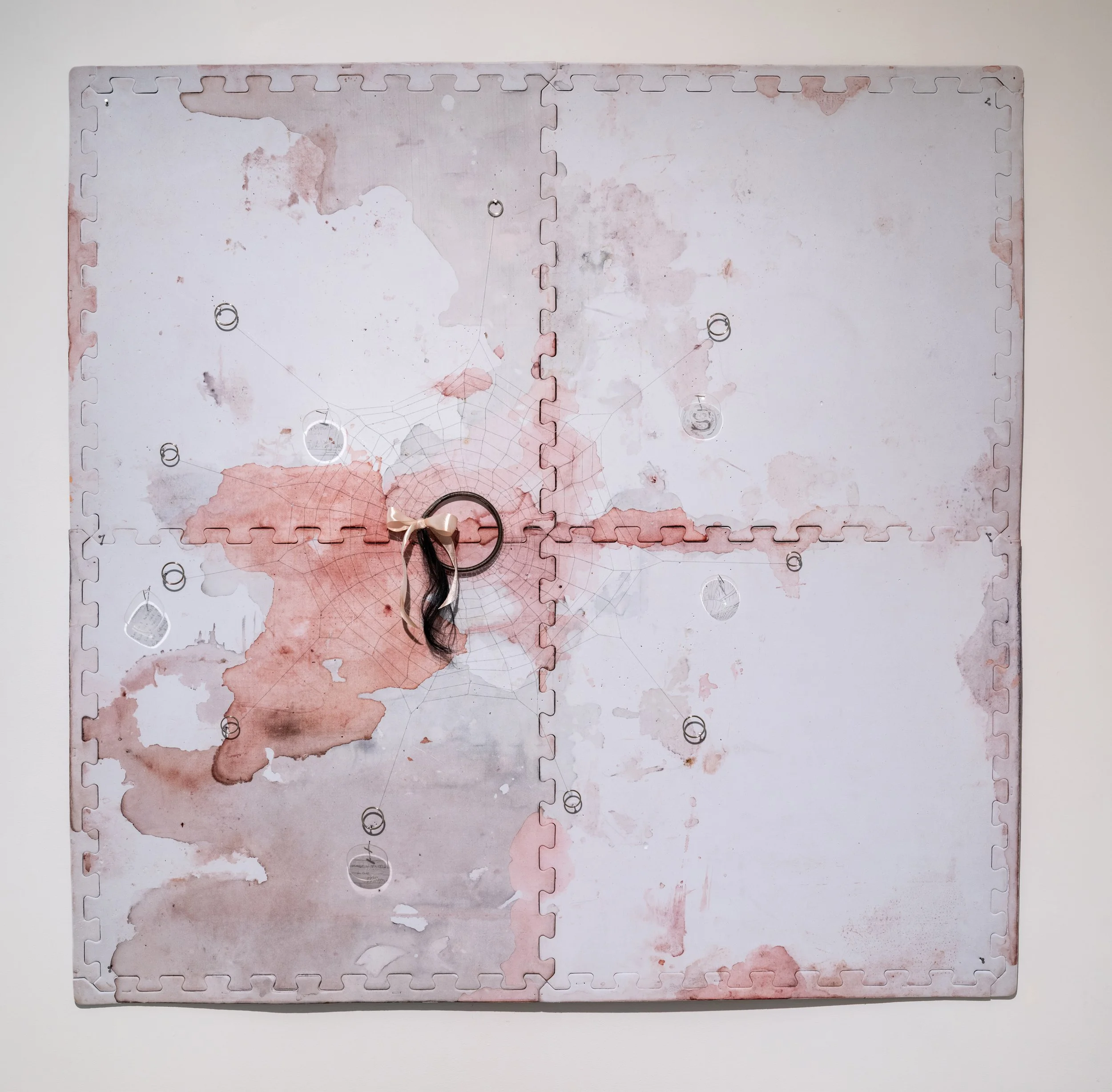
Spider map I (with memory plots), 2025. Foam tile mats, dye process from The Natal Lacuna, nylon thread, welded ring, metal O rings, nails, and tattooed lenses with the artists prescription. 48 x 48 inches. Courtesy of the artist.
Your installations often feel less like exhibitions and more like environments, spaces that implicate the participant emotionally and physically. When someone enters one of your worlds, what kind of awareness or confrontation are you hoping they carry with them?
Id hope they feel involved in some way. I think of my exhibitions and installations neater more presentable extensions of my studio, which I see as an ecology that engages with the different components of my practice. Dye run off from yarn appear on papers for drawings. Pieces from one flayed textile appearing as ruptures in another. Schizo notation from some reference gets collaged into another work. When someone steps into it, this world of physical and material attempts at understanding, I would hope they feel like there’s a place for them in it. To dig deeper, chew slower. Be rewarded for being a patient viewer.
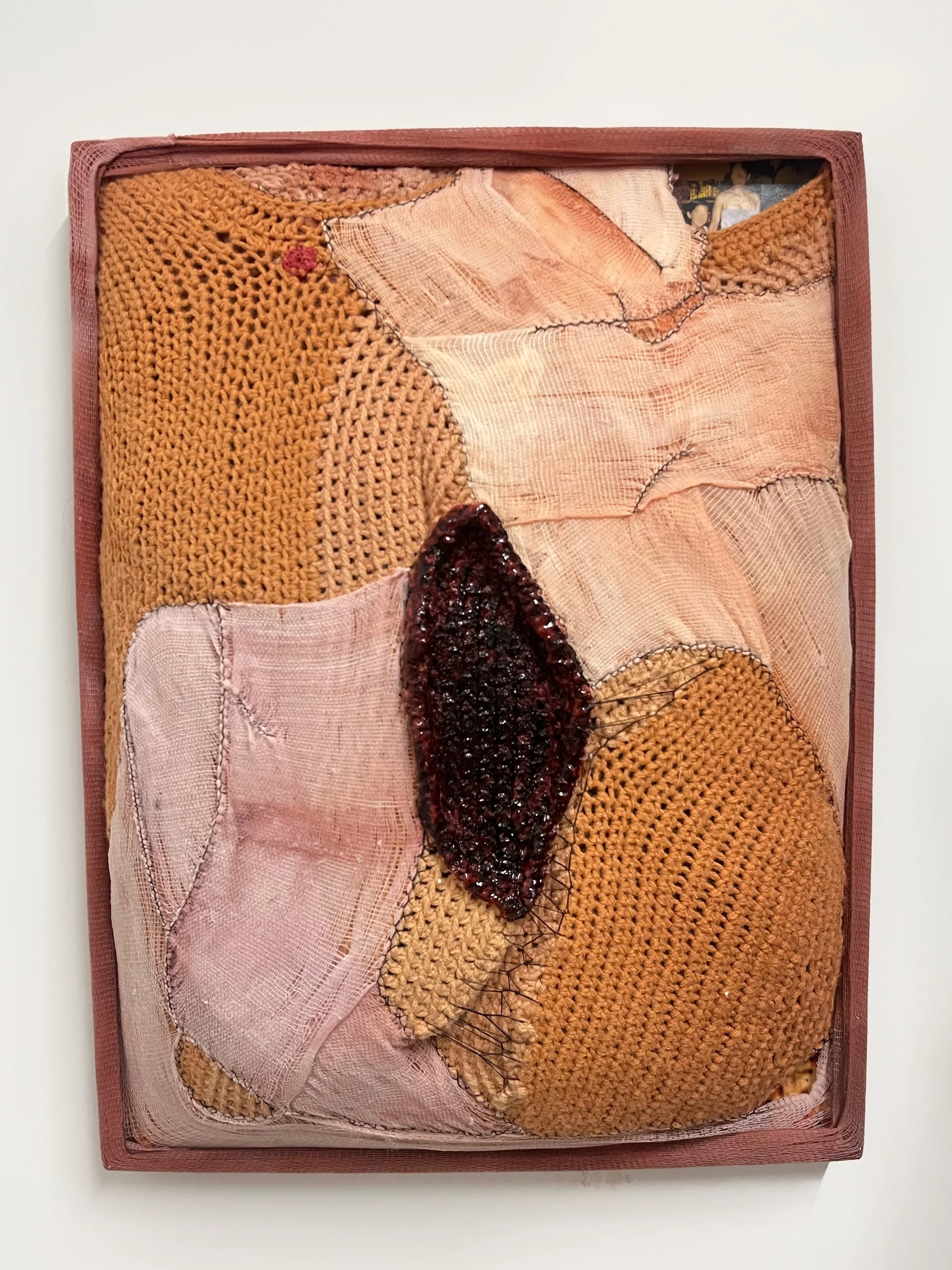
‘i’ and (m)’other’, 2026. Tulle, gauze, hand dyed yarn, thread, digital manipulated photo from the artists childhood, latex, and dye on found frame. 16.5 x 1.5 x 22 inches. Courtesy of the artist.
So much of your practice seems to circle questions of endurance, psychic survival, and the instability of embodiment itself. After years of constructing these forms through such labor-intensive processes, what has the work revealed to you about vulnerability?
Mainly that its the only way I know how to be, how to make. My art wont save me. It feels like it will at times, and then the mania settles and im hit with the realization that im just sitting in a windowless room, picking at a scab I just aided in healing over. People will see iterations of that healing in gallery settings or broadcasted on the internet. They will watch me spiral and stew in my duress online, seeing me create all this pain into something physical and outside of myself. It seems depressing, I feel I gave up a lot of my early 20s and it still wasn’t enough to completely fix me, or even offer me stability or safety. That being said there is something amazing about the whole ordeal, of being this vulnerable about my struggle, like an ouroboros, the snake chasing its tail, if i ever actually did reach oth other end I dont know what Id do with myself. I would rather chase it forever than have never known the chase, or than to ever reach the thing at all.
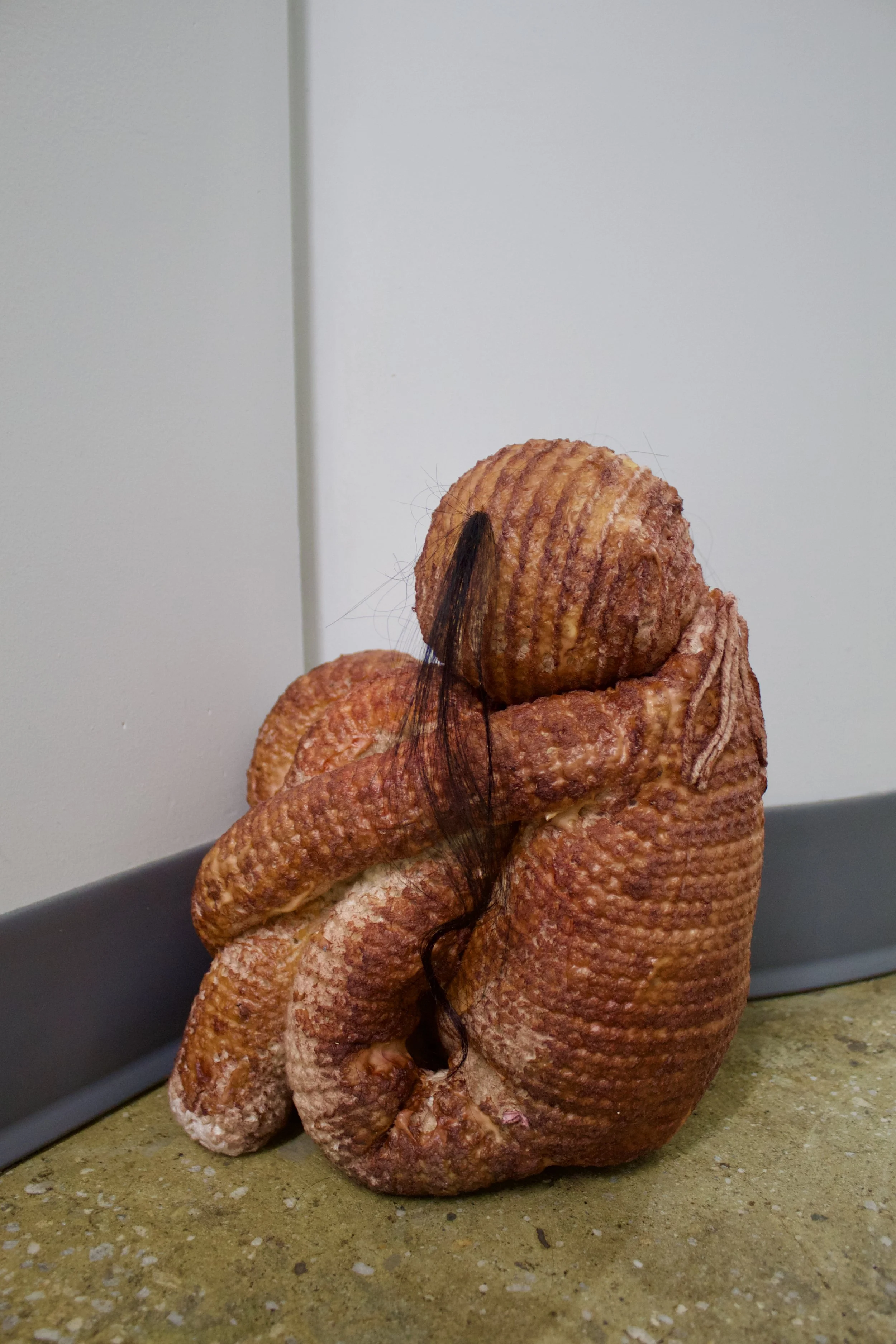
calcified self-victimization I, 2025. Yarn, dye, latex, tulle, thread and artists hair. 9 x 6 x 11.5 inches. Courtesy of the artist.
Looking ahead, are there any ideas, materials, or projects you have been developing recently that feel particularly important or exciting to you right now?
I've been looking into the umbilical cord more thoroughly. It’s always been something I’ve worked around especially with my interest in the transitional objects and its association with the placenta but this unifying component has yet to be a focal point. I recently pirated a textbook called Umbilicus and Umbilical Cord and have been enjoying all the ideas it's been conjuring. This also happens to coincide with a few people who are graduating from their MA in curation asking me to make work for their thesis exhibitions.
I’ve been really fortunate to connect with some amazing individuals through Instagram that are young and starting in their careers. It’s allowed for a sense of reciprocity and candor when it comes to studio visits that I’m really grateful for. They’re also just insanely brilliant in general so I feel very fortunate to be able to connect and be in discussion with them. I’m excited to see where the pieces go especially as the work converses with that of the other artists in their curation.
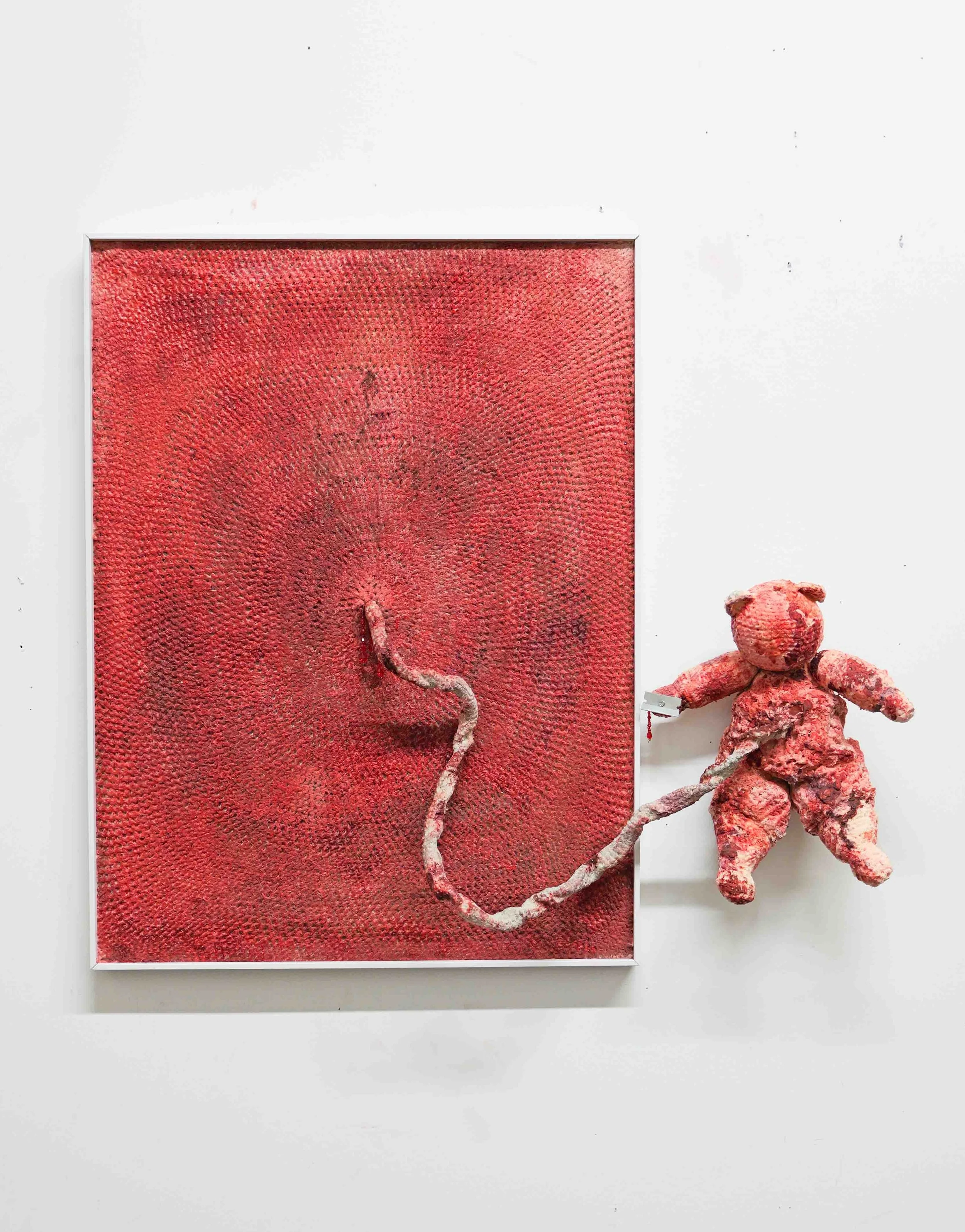
detachment theater I, 2026. Hand dyed yarn, latex, beads, thread, tulle, dog hair (eeny), razor blade and foam ball on found frame. 34 x 37 x 5 inches. Courtesy of the artist.