Maddy Inez talks to Phillip Edward Spradley
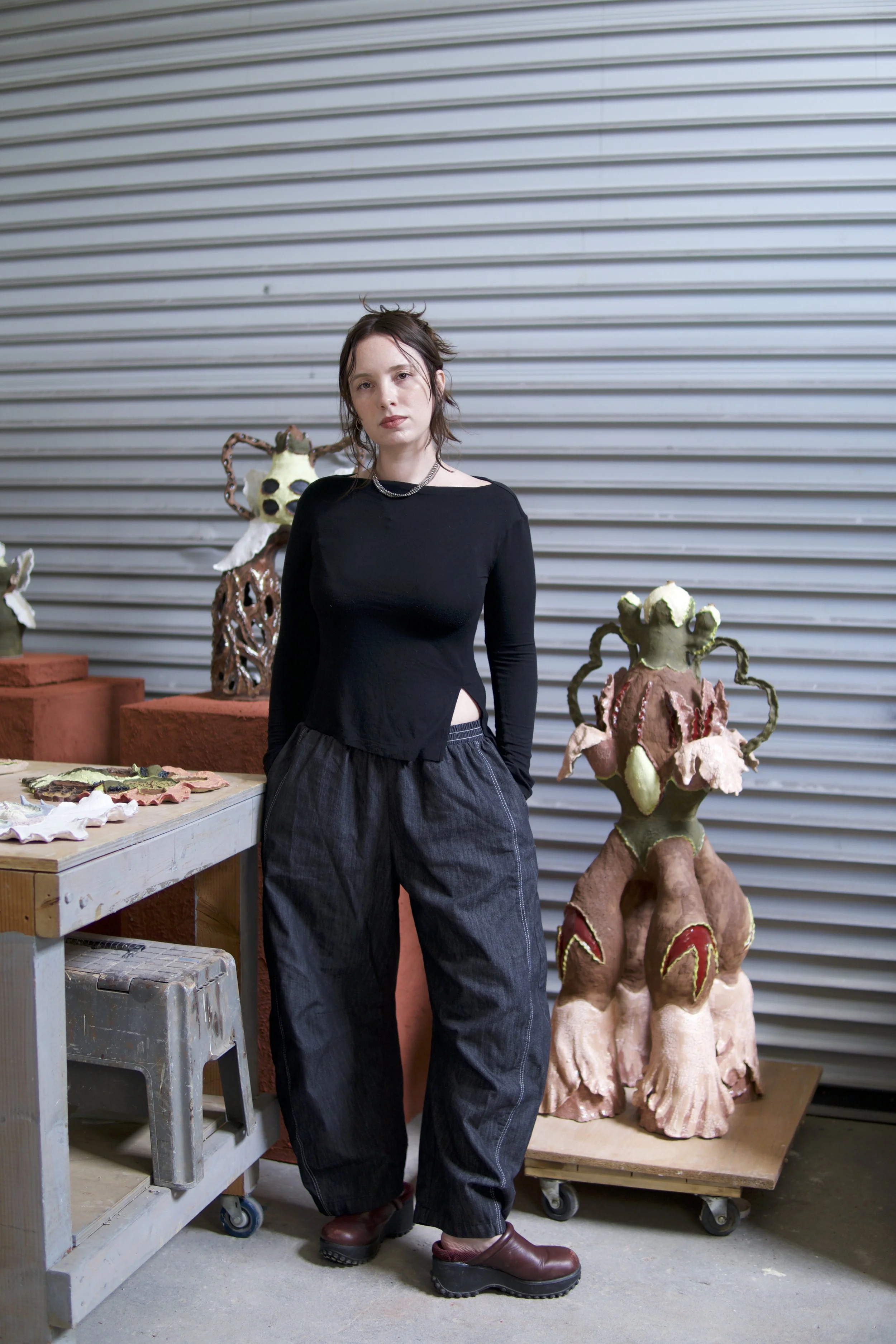
Portrait of Maddy Inez. Courtesy of the artist. Photo: Harlan Gleeson
Those deeply connected to a place develop a unique sensitivity to its rhythms, including its climate, landscapes, and emotional tone. For Maddy Inez, California is more than a setting; it is a living record of contrast, where beauty and instability exist side by side. Her work grows out of this duality, drawing connections between the state’s rich natural environment and its layered histories of displacement, environmental change, and inherited knowledge.
Working primarily in ceramics, Inez uses form as both a visual and storytelling tool. Each vessel is distinct, shaped with a sense of individuality that resists repetition. Rather than striving for uniformity, she embraces variation, allowing each piece to reflect a different experience or perspective. The surfaces of her sculptures often resemble elements of plant life, such as petals, seed pods, or roots, while also suggesting the human body as a carrier of memory. In this way, her works function not just as objects, but as containers for stories that are difficult to express through words alone.
A key aspect of Inez’s practice is her focus on maternal lineage and the transmission of knowledge outside formal institutions. Family legacy, oral history, and independent research all inform her approach. This interest deepened when she discovered a midwifery certificate belonging to her great-great-great grandmother, dating back to the era of enslavement. Rather than viewing this as a static historical document, Inez uses it as a starting point to explore the broader role of midwives, particularly their expertise in plant-based medicine, and how this knowledge has been both overlooked and preserved across generations.
Her work extends beyond the studio into an ongoing engagement with the natural world. Inez’s interest in plants shapes her attention to color, fragility, and care. Cultivating and tending to plant life becomes part of her creative process, reinforcing an awareness of growth, vulnerability, and maintenance. This expanded approach places her work within a broader ecological perspective and emphasizes the interconnectedness of human and botanical life.
Community also plays an important role in her research. Through conversations with land stewards, farmers, and herbalists across Los Angeles, Inez develops a deeper understanding of local ecosystems and their cultural significance. These exchanges influence how she approaches California plant life, not simply as visual inspiration, but as living markers of migration, adaptation, and history. Both native and introduced species reflect patterns of movement and survival, echoing the personal and collective narratives present in her work.
Inez’s practice moves between sculpture and research, science and spirituality, and the personal and the collective. Her work encourages viewers to think about how history is carried through objects, landscapes, and inherited forms of knowledge that persist over time. She creates work that reflects both the beauty and complexity of the world around her, offering a thoughtful exploration of care, memory, and transformation.
Inez lives and works in Los Angeles. She earned a BFA from the Pacific Northwest College of Art in Portland, Oregon. Her work has been exhibited at Harkawik Gallery in New York, as well as Murmurs, Sebastian Gladstone, the Japanese American Cultural & Community Center, and NOON Projects in Los Angeles. Her work is held in the permanent collection of the DePaul Art Museum.
Her upcoming solo exhibition at Megan Mulrooney Gallery opens May 16, 2026 and runs through June 20, 2026.
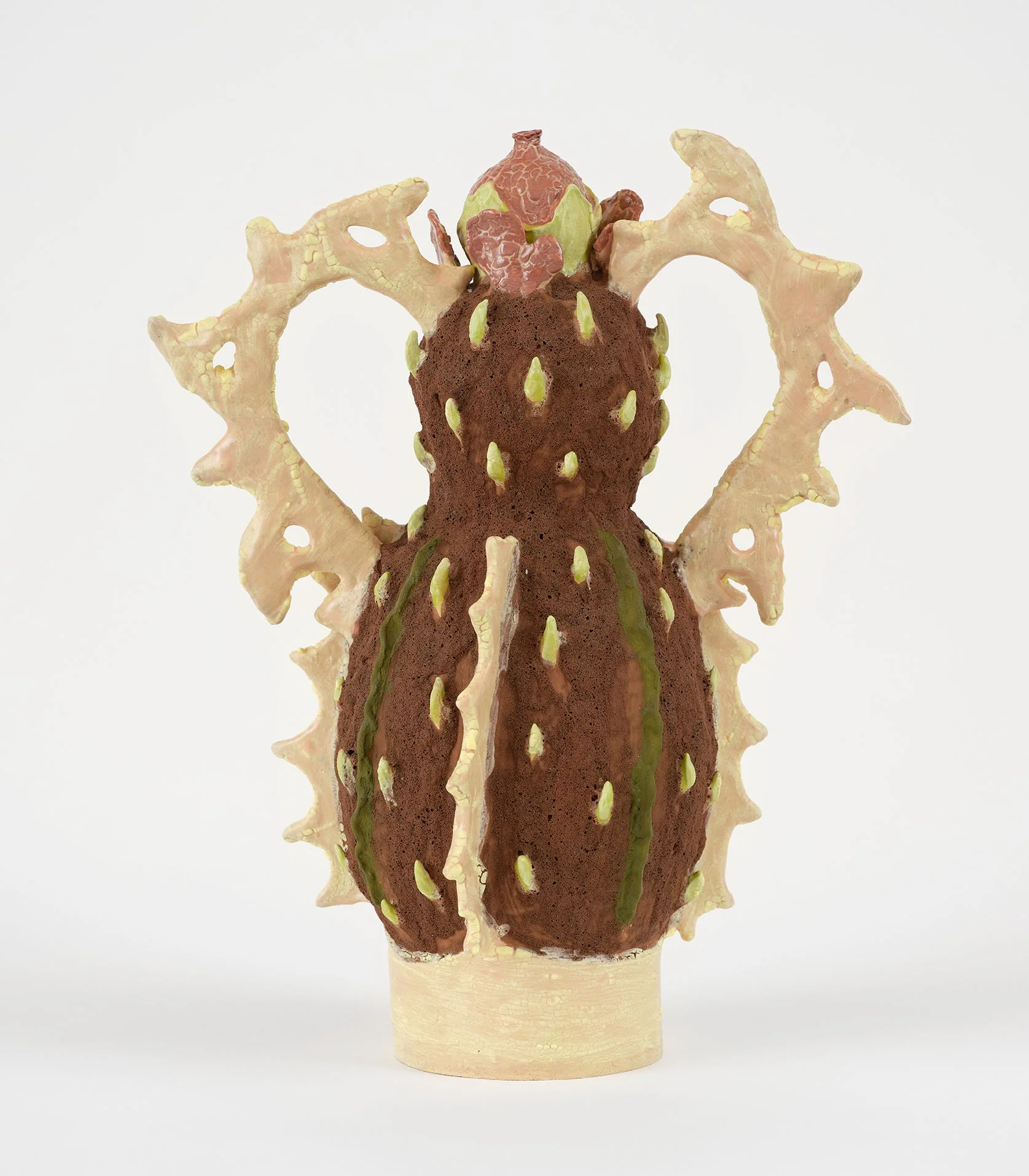
Za’atar Pistil, 2026. Glazed Ceramic, 16 1/2 x 13 x 8 inches. Courtesy of Megan Mulrooney and the artist. Photo: Paul Salveson
Phillip Edward Spradley: Curious to know how did you find ceramics, or how did ceramics find you. Was there a particular moment when clay began to feel like a necessary language rather than a chosen medium?
Maddy Inez: My grandfather was a ceramist and he taught me how to work with clay. I have fond memories of him leaving me with a bag of clay while babysitting me. From then I’ve always worked in clay, I was the ceramic tech in high school where I learned how to fire kilns and throw on the wheel. It wasn’t until my last year of college that I started thinking about the medium as a conceptual art material to work in. Mediums have content and clay has a long history in humanity that lends to my practice. There is something innate in the relationship between human and clay that I’m drawn to and that I think the viewer is too. From the first humans creating vessels to eat from and carry seeds as they migrated, to creating votives of our gods, to our favorite mug; clay as object holds meaning and history. It’s a relatable medium, and as humans we look for ourselves in clay vessels.
How has your ancestral lineage reshaped your understanding of making as a form of healing, ritual, or continuation?
Growing up in a mixed household, I was taught a lot of different beliefs and ways of healing. Mainly through tea or the food we ate, but the idea of using magic to heal was always around. When I found the midwifery certificate of my great-great-great grandmother it made me think of how she healed her people after slavery, and made me question what the enslaved midwives garden looked like. This inspired the more expansive research for my current body of work, but it also felt validating finding evidence of healers in my lineage. Art making is also part of that inheritance. It’s how my family process the world and move through it.
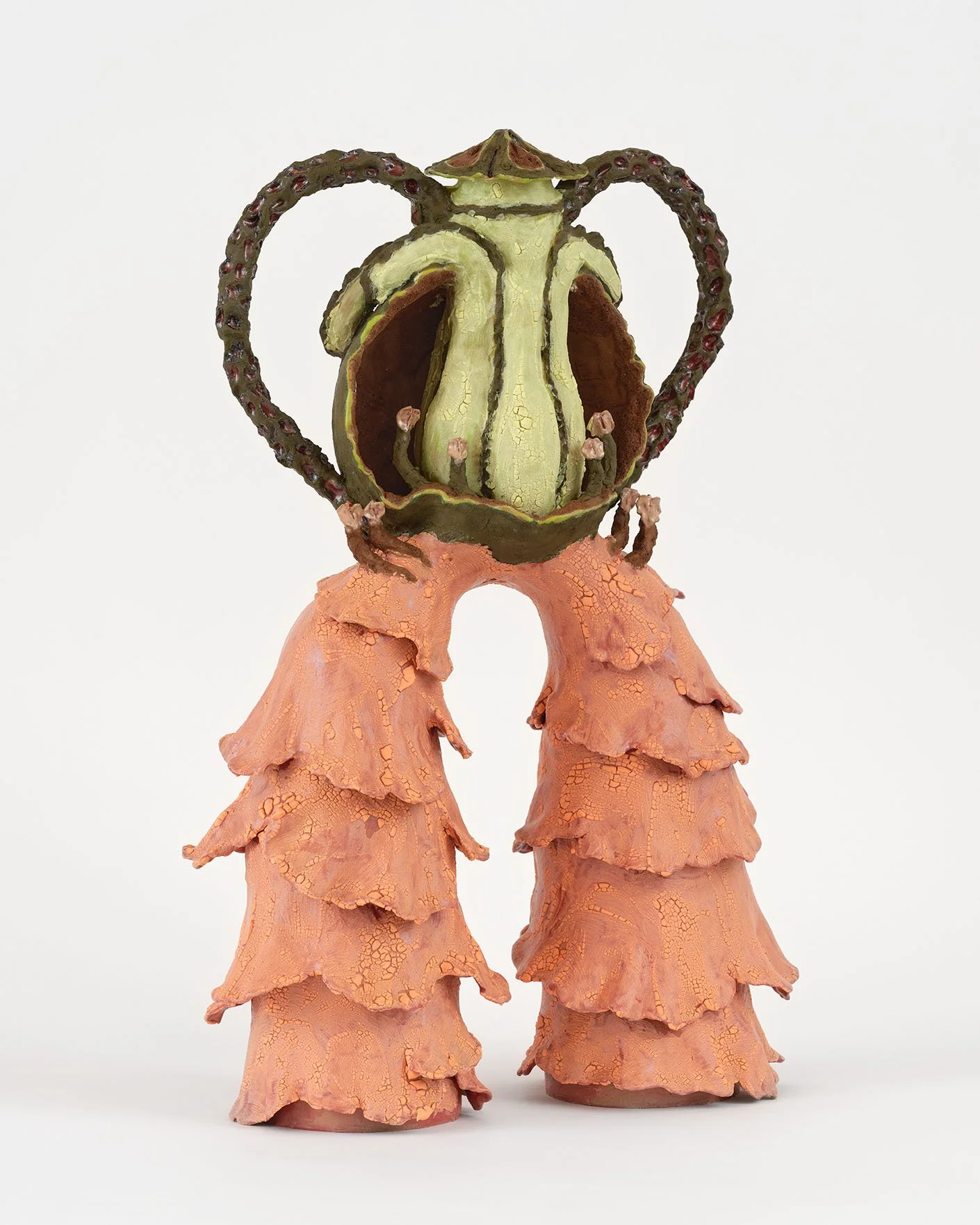
Blood Bloom, 2026. Glazed Ceramic, 24 1/2 x16 1/2 x 8 inches. Courtesy of Megan Mulrooney and the artist. Photo: Paul Salveson
How do you navigate the space between what is remembered, what is researched, and what must be imagined in order to give these histories form?
My sculptures are the product of navigating that space. They are the accumulation of lore, myth, history and spirit. I research medicinal practices, legends of plants, and history all while bearing witness to things happening in this world now such as climate change, violence, and greed. The act of making becomes a way to process and hold all of that information.
Engagement with plant life extends beyond metaphor into daily practice. In what ways has tending, observing, and growing plants shifted your sensitivity to time, fragility, and transformation within your work?
I definitely notice season more while researching plants. Everyone always says Los Angeles doesn’t have seasons, but we do. I often mark them by the plants that visit my garden beds every year unprovoked. Right now it’s Blue Bells and Nasturtiums. I don’t plant these plants they just come with the wind or self populate from previous years. I once made a sculpture about a nasturtium inspired by the ones in my garden but also one of my favorite Anne Spencer poems Line’s to a Nasturtium.
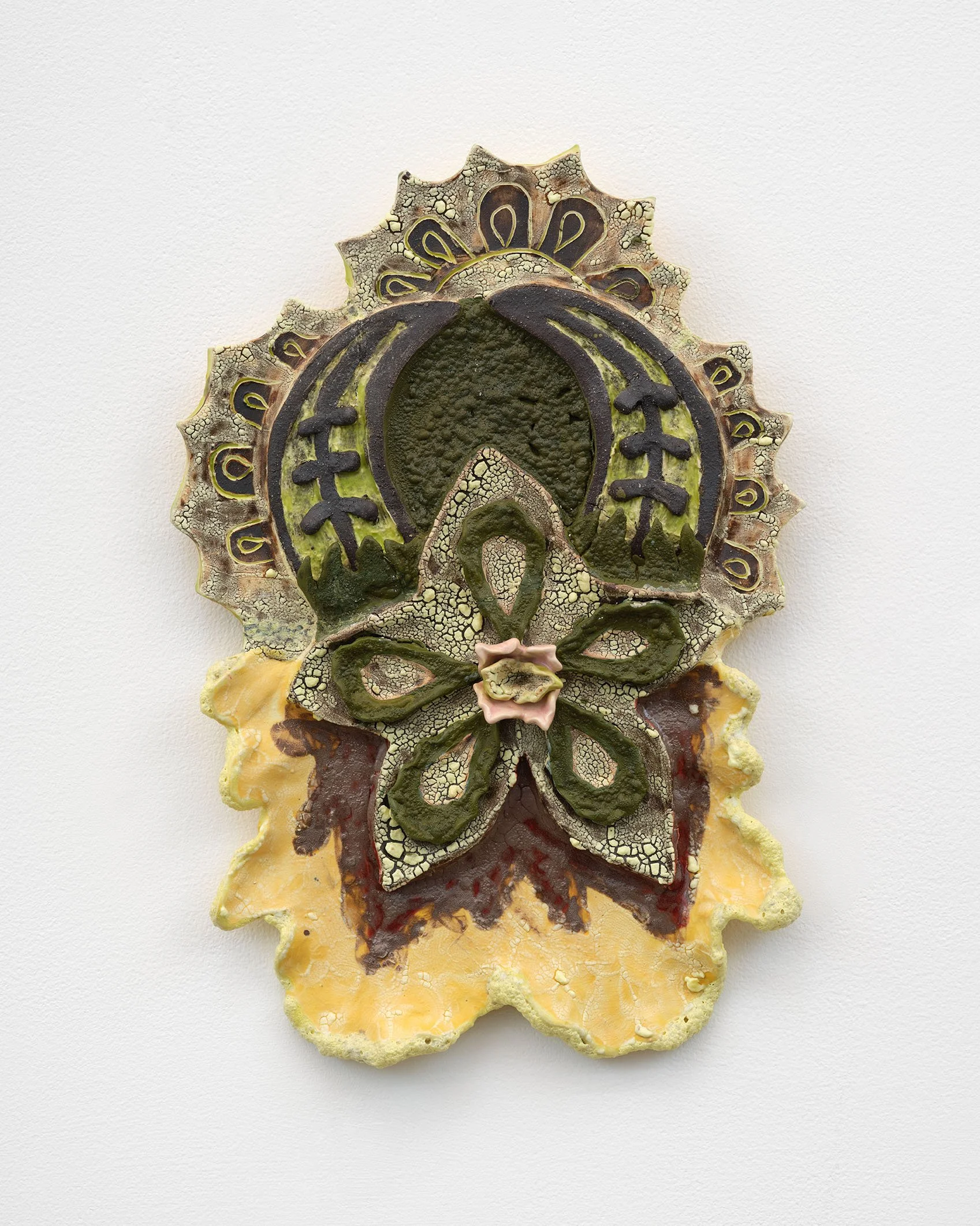
Gumbo Rising, 2025. Glazed Ceramic, 15 x 9 1/2 x 2 1/2 inches. Courtesy of Megan Mulrooney and the artist. Photo: Paul Salveson
Each vessel you create carries a sense of individuality, as though it has its own internal logic or temperament. Can you speak to your process of understanding the physicality and the underlying structure, life force, of your subjects and how those qualities inform the forms you create?
I always start with a point of research. In my current body of work, I’m researching gardening as an act of resistance and looking at gardens of folks that have been displaced due to colonization. I’m looking at plants from Lebanon, Sudan, Palestine, Congo, and plants that were brought to the States through the transatlantic slave trade.
After researching specific plants I will look at the botanical drawings of the plant. I will even sometimes bring the physical plant into my studio and look at it under the microscope. Then from the different parts of the plant—the seed, the bloom, the root—I will create a drawing of my vessels. I like to think of my sculptures as votives of the spirits of these plants.
Your sculptures often seem to exist between states, blooming and collapsing, holding, and releasing. Are you actively communicating a recurring lifecycle or is this sense of cyclicality a projection arising from my own perception as a viewer?
I love that you see this in my work. When I’m creating a sculpture, I’m looking at a plant in different stages, it’s seedling, sprout, bloom, and dried husks. I’m also looking at cycles of history and life while I’m researching. I think having a relationship to plants and agriculture makes you notice the cycles and patterns in society and culture. I want my artwork to make people notice these cycles both in the natural world and in a manmade societal structures.
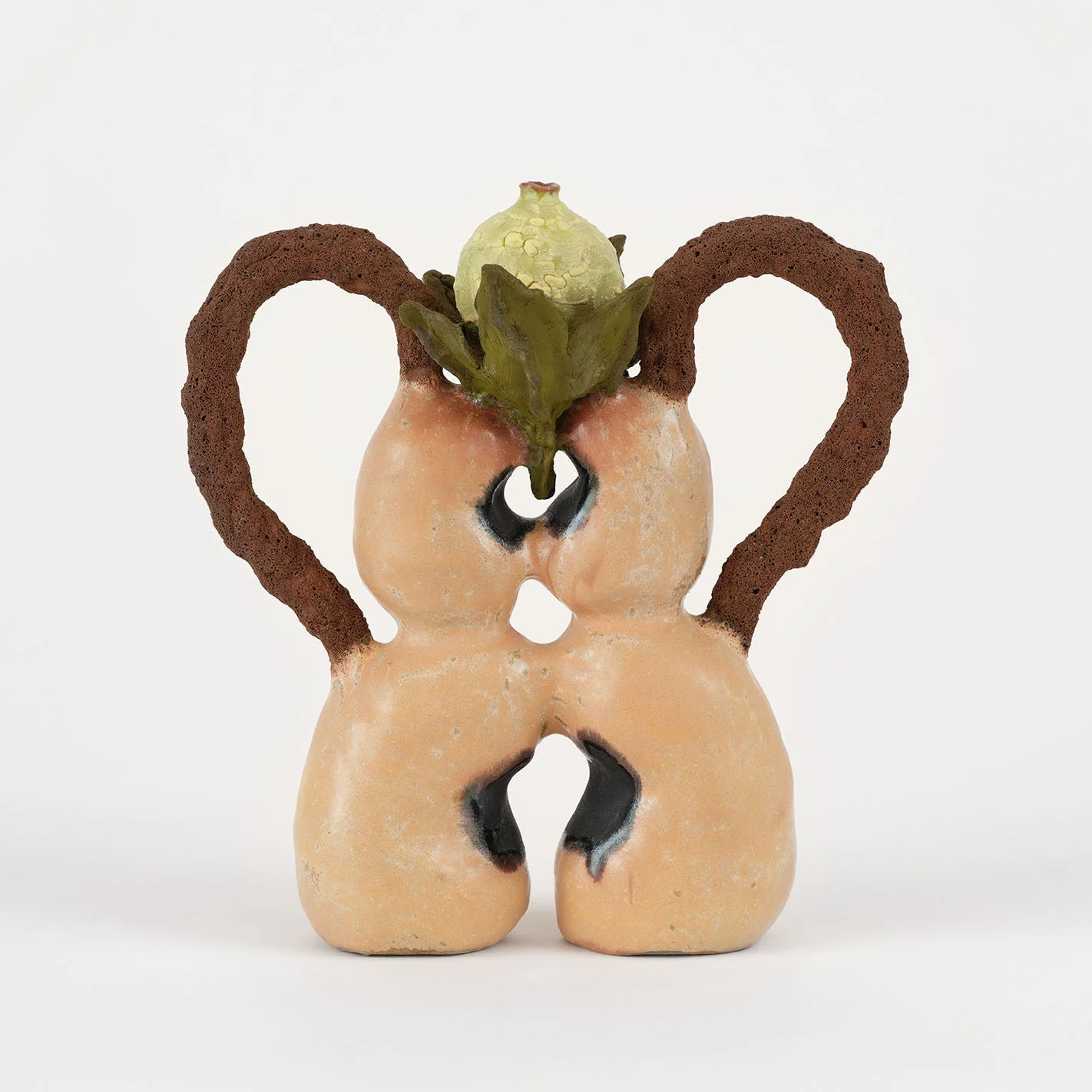
Juju Bean, 2026. Glazed Ceramics, 9 x 9 x 4 1/2 inches. Courtesy of Megan Mulrooney and the artist. Photo: Paul Salveson
What is the greatest challenge in translating those drawings into clay? Do you find that something is gained or lost in that transition?
My sketchbook is an essential part of my making process. I will make detailed drawings of seeds and blooms of the plant and then assemble those parts into parts of my vessels. Almost like an exquisite corpse, the bloom of the plant will become the legs of my vessel, the cross section of a seed will become the head. I then use water color to color my sketches, which is more of an exploration of how I will glaze my sculpture than a study of color of the plant. Sometimes the color is derived from the plant, but when glazing I’m really interested in textures. Sometimes things don’t translate from drawing to sculpture just on the basis of gravity won’t allow it. Things are lost or changed just by how my hand interacts with the clay or through the transformation that happens in the kiln.
In your investigations, was there a particular standout plant or flower species that surprised you, whether in its history, its behavior, or its relationship to the land?
This is such a hard question because I feel like I fall in love with each plant I’m researching.
While working on this show I interviewed a lot of land stewards, gardeners, and educators, and I asked them what plant resembles resilience to them. I was surprised that I had made a sculpture for almost every plant that they answered with. I talked with Nina, from Altadena Seed Library, about fire followers which are California wild flowers that need smoke and fire to germinate. I made a series of sculptures based on these flowers after the Altadena fires last year.
The one flower that has really stuck with me, and happened to be Nina’s answer to my question, was the Matilija poppy. There is a Chumash story that the flower was born from a passionate love and loss. It is a symbol of the beauty that can grow from destruction and devastation. Which is something I hold onto in these times of darkness, my little Matilija torch of hope.
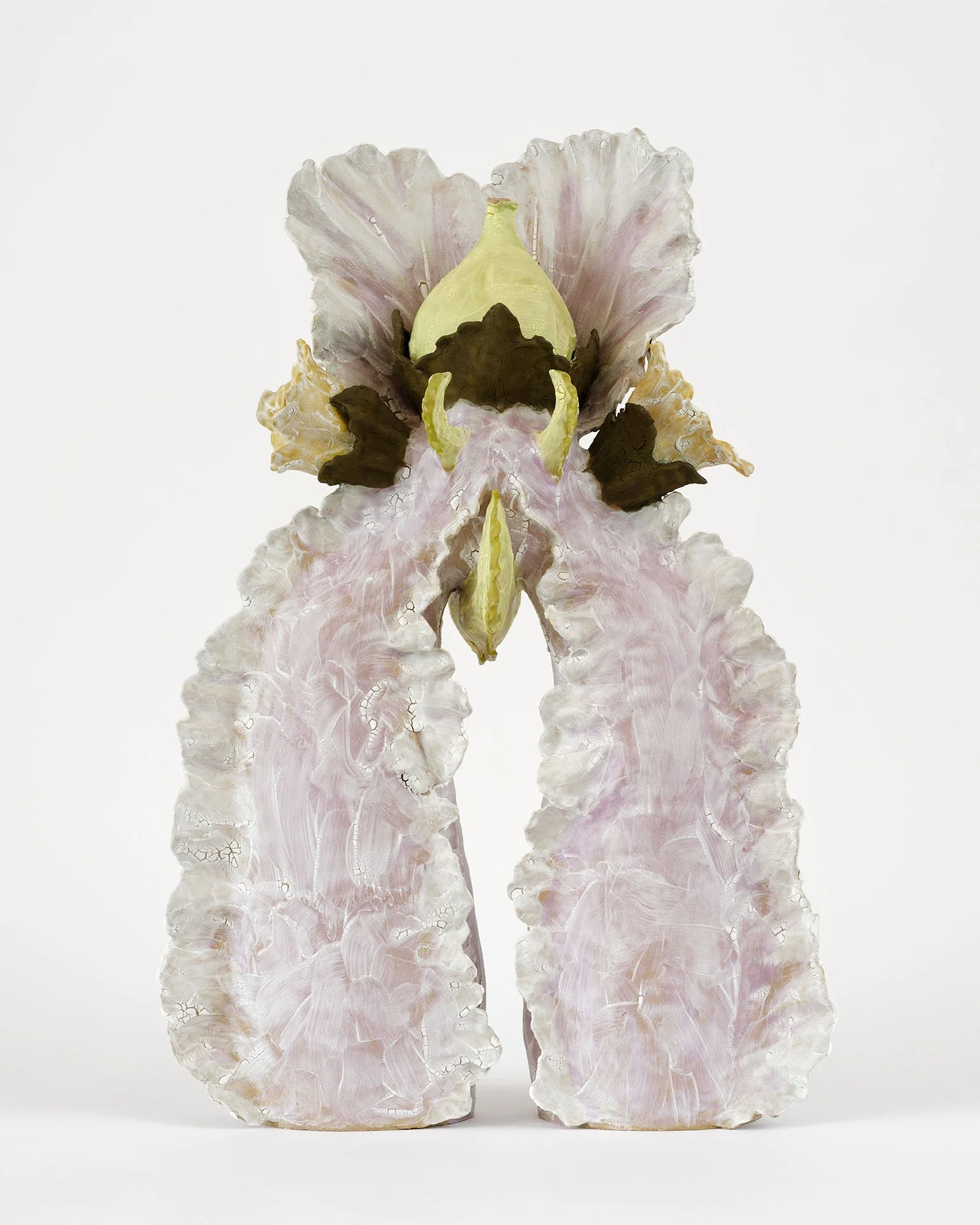
Black-eyed Angel, 2026. Glazed Ceramic, 26 x 18 x 5 inches. Courtesy of Megan Mulrooney and the artist. Photo: Paul Salveson
Many of your works evoke both vulnerability and resilience. How do you approach fragility, whether in the material of clay or in the histories you are engaging, without reducing it to something fixed or easily defined?
Is history not fluid? I think we are seeing how easy it is to rewrite history in real time now. Truth and fact can be easily erased by fear and ego.
Clay is a great example of vulnerability and resilience. When clay is plastic its fluid, before it’s fired it’s fragile, but after it’s been fired its very strong. There is a permanence in ceramics that sometimes frightens me. There is a chance my sculptures will outlive humanity, buried under rubble in some dystopian future. I would hope if someone in that future found my sculptures they wouldn’t see them something trying to provide a fixed answer but instead something that poses questions about the world I live in now.
Looking ahead, what questions or forms feel urgent to you right now? Are there materials, histories, or landscapes you feel called to explore more deeply?
Looking ahead I hope to continue this research. I want to continue talking to gardeners, land stewards, and educators about this idea of gardening as an act of resistance. I hope to travel outside of Los Angeles, and hopefully out of the States, to conduct interviews. I think this community of people are the answer to a way forward. There is nothing more powerful than planting a seed in hopes that we will be around to harvest it in the future. It’s a promise of survival.
To learn more about Maddy Inez visit her Instagram.